Every solvent extraction operator meets it sooner or later: a grey, brown or black band of gunk that settles at the interface between organic and aqueous phases and refuses to go away. The industry calls it crud (also rag layer, interfacial gunk or goo). It is not a single chemical — it is an emulsion stabilized by solids, and once it establishes itself it degrades every part of the circuit: phase disengagement slows, organic inventory balloons, entrainment losses climb, and extraction efficiency drifts downward.
This note covers what crud actually is, the five mechanisms that create it, and the prevention and treatment playbook used in operating circuits.
What Crud Is (and What It Is Not)
Crud is a stable dispersion of fine solids locked at the liquid–liquid interface. The solids — typically sub-micron silica, iron hydroxide colloids, gypsum fines or degraded organic degradation products — are wetted partially by both phases, so they lodge at the interface instead of reporting to either phase. Once enough solids accumulate, they form a mechanically stable film that holds droplets of both phases apart.
That definition matters because it explains the symptom pattern:
- Phase disengagement time increases — the interface becomes a physical barrier between droplets.
- The interface line turns blurry or "band"-like instead of a crisp boundary.
- Entrainment rises in both directions — organic carries away aqueous droplets and vice versa.
- Organic inventory grows — crud can hold several times its own volume in trapped organic.
What crud is not: it is not simply "dirty feed", and it is not the same as bulk emulsion. A bulk emulsion disperses both phases through each other and usually breaks when agitation stops. Crud is interfacial — it sits in a defined layer and survives long settling times.
The Five Causes of Crud
1. Fine Solids in the Feed
The dominant cause in most plants. Flocculated silica, clays, iron/aluminium hydroxides precipitated by local pH excursions, and unreacted ore fines all find their way to the interface. Leach circuits that run hot or over-agitated generate more colloidal material, and colloids are exactly what crud feeds on.
2. Organic Degradation
Extractants and diluents degrade over time through oxidation and hydrolysis, producing interfacially active fragments. These degradation products behave like surfactants: they lower interfacial tension and rigidify the interface, making it easier for solids to anchor.
3. Gypsum and Scaling Species
In circuits treating sulfate liquors, calcium chemistry can precipitate gypsum at the interface, where local supersaturation is highest. Gypsum needles are efficient crud builders.
4. Biomass
Bacterial and fungal growth on the organic phase — a recognized problem in circuits with long organic residence times or warm, shaded tank farms — produces hydrophobic biomass that joins the rag layer.
5. Mechanical Over-Agitation
Excessive mixing energy shears droplets to a size where they take hours to coalesce, giving solids an open window to stabilize them. This is the one cause that is entirely within the designer's control.
Prevention: Keep Solids Out and Energy Down
Prevention is almost always cheaper than treatment. In order of leverage:
- Clarify and polish the feed. Every micron of suspended solids removed before the first mixer-settler is a micron that never reaches the interface. Sand filters, cartridge polishing filters or thickener overflow control all work; the right choice depends on solids loading.
- Control mixing energy density. Mixing is for mass transfer, not for making emulsions. Modern mixer-settler practice targets a specific power input per volume (P/V) in the mixers and gentle pumping action on the draft tube — enough to disperse, not enough to shred.
- Design the settler for real disengagement time. A settler sized on residence time alone, without accounting for the actual phase-disengagement rate of your system, will show a growing rag layer within weeks of start-up.
- Keep pH excursions localized. Hydroxide colloids form where pH spikes. Good reagent control and rapid mixing at the addition point matter.
- Regenerate the organic on schedule. Clay treatment or acid wash removes degradation products before they accumulate. Treat this as maintenance, not as an emergency response.
Treatment: When the Rag Layer Is Already There
When crud is established, the treatment ladder runs from least to most invasive:
- Interfacial skimming. Dedicated crud hoppers or skimmer weirs on the mixer-settler let operators remove the rag layer continuously. This is the standard layout in PP and PMMA mixer-settler boxes — the interface is visible and accessible.
- Crud processing. Skimmed crud still contains valuable organic, so it goes through a break-and-recover step: acid/alkali wash, centrifugation, or heating to break the emulsion and reclaim entrained organic. Recovered organic returns to the circuit; the solids go to tailings.
- Organic regeneration. Clay treatment (activated attapulgite or bentonite) adsorbs degradation products and restores interfacial tension.
- Circuit wash-down. In severe cases, a planned wash of the settler internals and a fresh organic make-up is the reset button.
Design Notes for New Circuits
If you are specifying a pilot or production SX circuit now, the crud lesson translates into three design requirements:
- Visible interface. Transparent or sight-glass-equipped settlers let operators see the rag layer forming weeks before it becomes a crisis.
- Accessible skimming. The settler should have a designed place for crud to go — not an improvised one.
- Moderate mixer energy with good pumping. The mixing system should be selected for the mass-transfer duty, with the impeller doing pumping first and dispersion second.
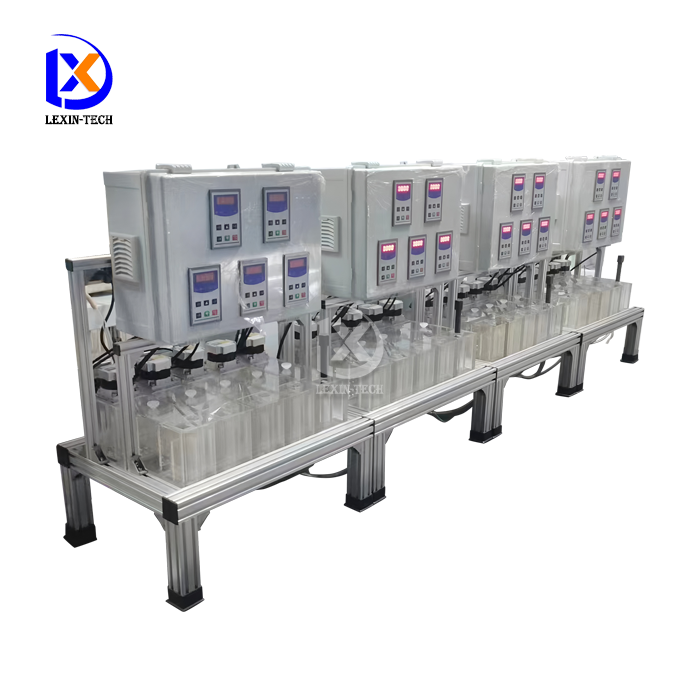
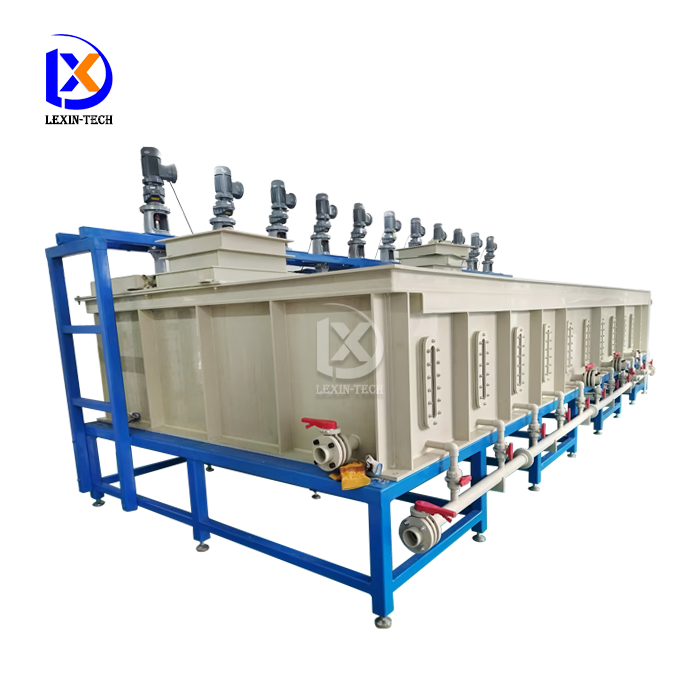
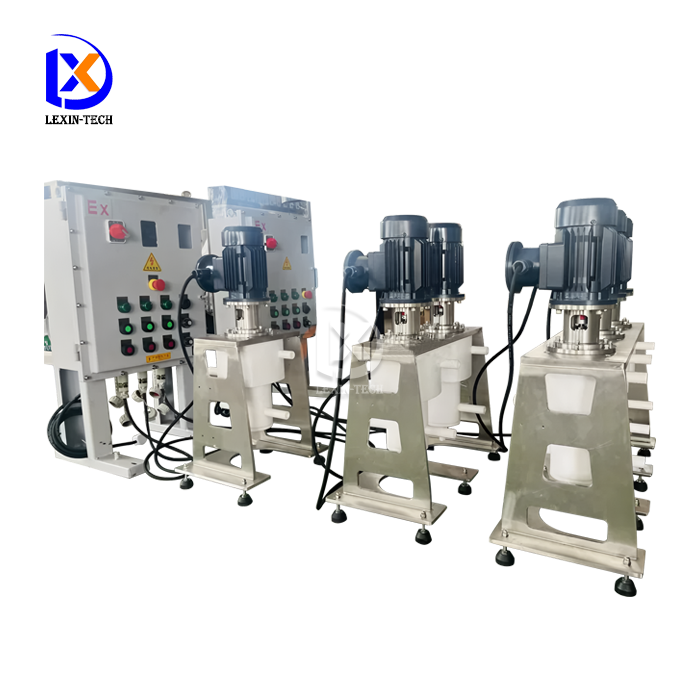
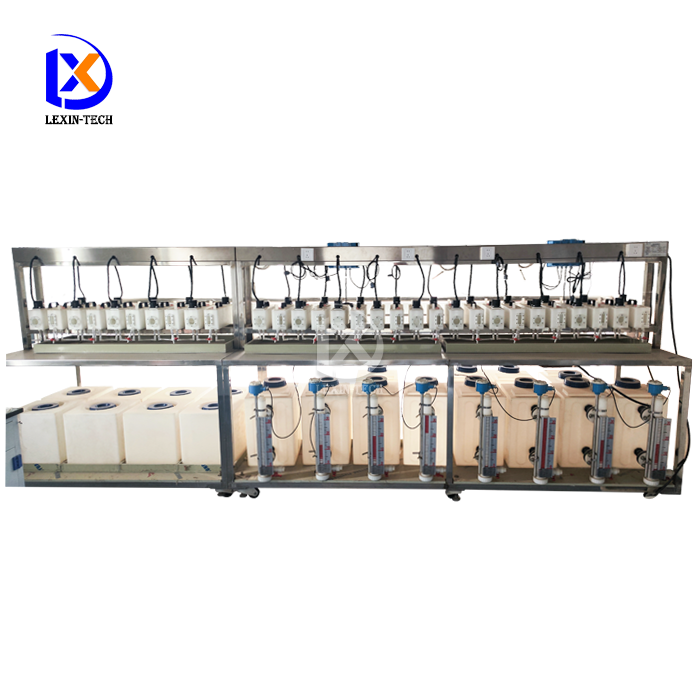
Our PP mixer-settler series and transparent PMMA mixer-settlers are built around exactly these requirements for lab and pilot circuits; the turbine extraction columns cover the cases where column geometry is the better fit.
FAQ
Is crud always a sign of bad operation?
No. Some feed systems generate crud no matter how well the plant runs — certain ores carry inherently colloidal gangue. Good design limits the impact: skimming capacity, organic recovery and regeneration.
Does crud mean my extractant is spent?
Not necessarily, but persistent crud with clean feed is a classic sign of organic degradation. An organic analysis (interfacial tension + degradation product assay) settles the question.
How much organic gets trapped in crud?
Field reports range from 2 to 10 liters of organic per liter of crud depending on how stable the emulsion is. That is why crud recovery pays for itself quickly at solvent prices.
Can a centrifugal extractor avoid crud problems?
Centrifuges handle some crud-prone systems better because residence time is seconds, not minutes — less time for solids to stabilize an interface. But the solids still have to go somewhere, and disc-stack centrifuges themselves foul. For lab and pilot work with limited solids, mixer-settlers remain the workhorse.
What mixing intensity should I run at?
There is no universal number — it depends on your system's coalescence behavior. This is exactly what a pilot campaign establishes. As a rule of thumb, if you can carry droplets out of the settler, you are over-mixing.