Laboratory Settling Test Column
PriceOn request — quoted against your specification
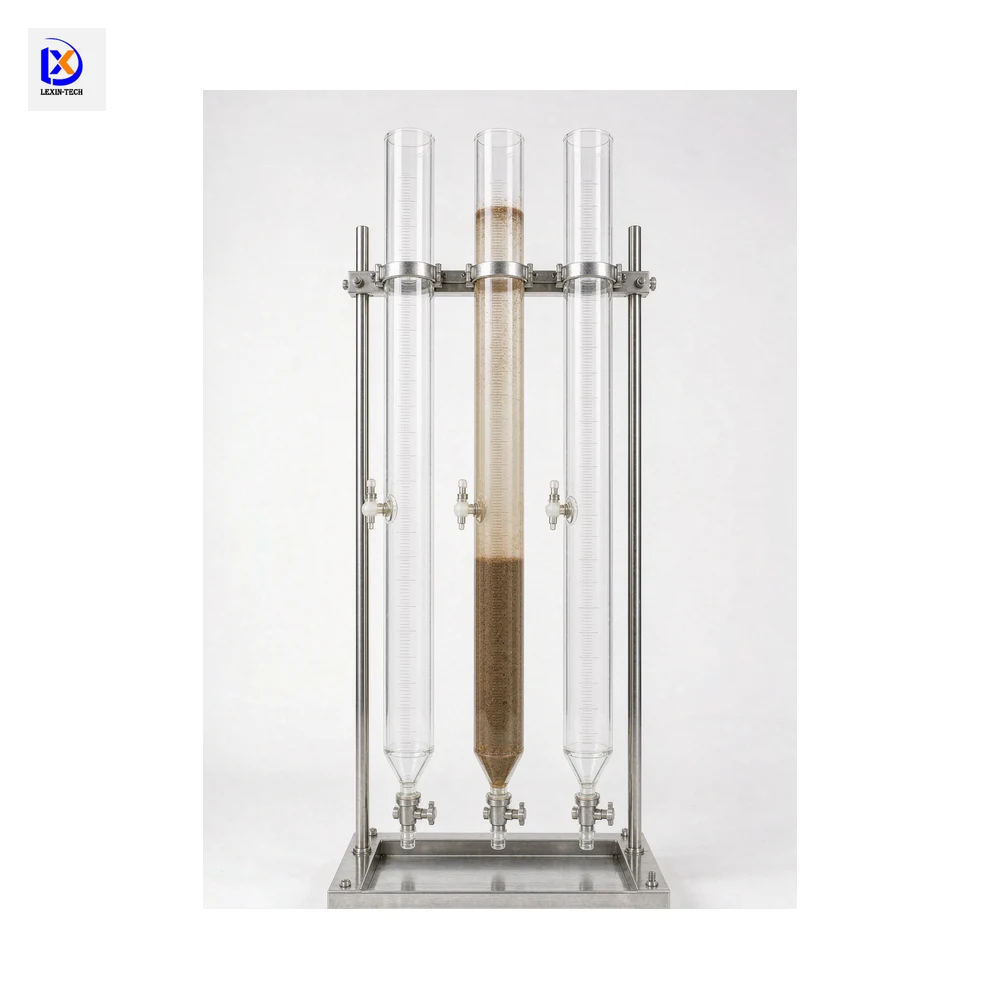
Transparent PMMA settling columns, 100 mm x 1,500 mm, three per stand, moulded scale, PTFE sampling ports — for flocculant and thickener design test work.
- Built to order
Engineered against your feed assay and throughput - Bench & pilot tested
Sample testing before the flowsheet is frozen - Export documented
Pre-tested, skid-mounted, documented for customs - EN / ES / RU / AR
Technical support in four languages
A settling test column is the cheapest way to get a thickener design out of a bench test: a 100 mm bore, 1,500 mm tall transparent column, three of them side by side on one stand, so a flocculant dose can be compared against a blank in the same afternoon.
What the column actually measures
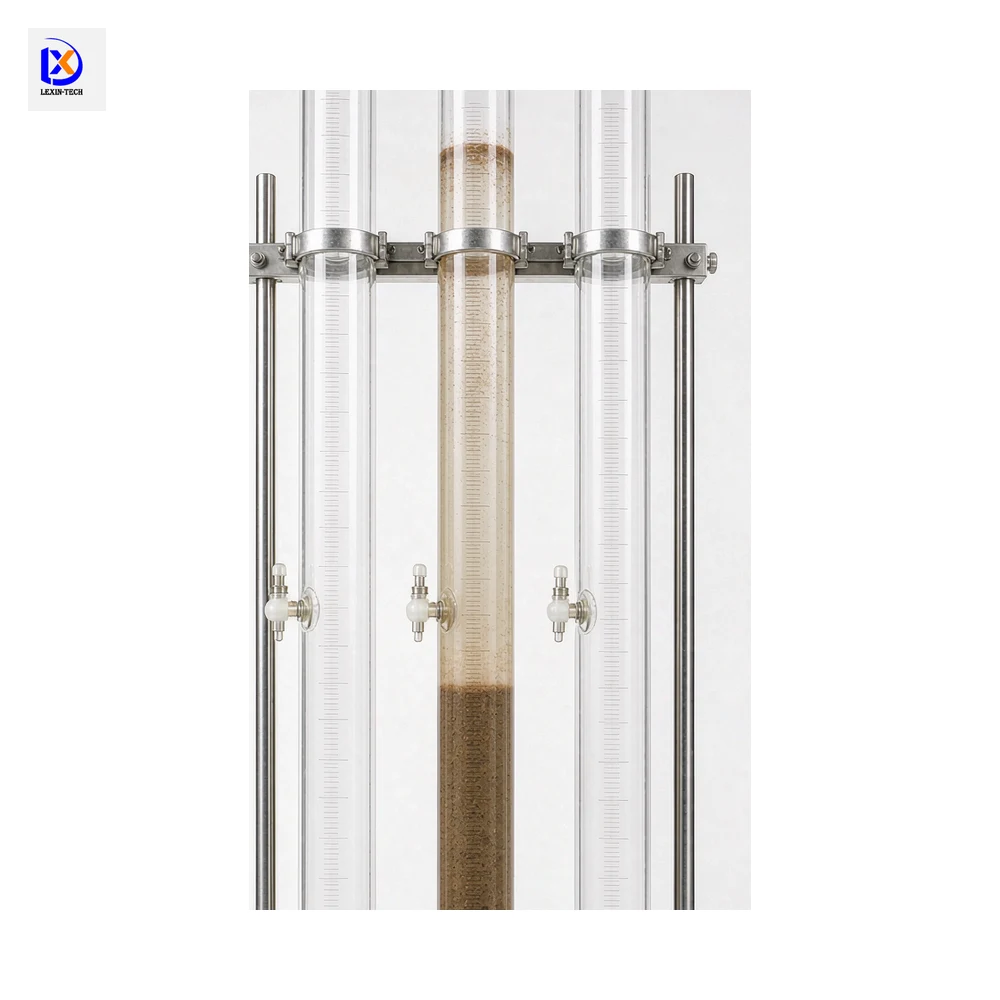
Feed slurry is flocculated in a beaker, poured in, and the mud line is read against the moulded scale on the wall — height against time. Three numbers come out of that curve: the free-settling rate in m/h, the point where the pulp enters compression, and the underflow density if the column is left long enough. Those three set the thickener diameter, the depth of the compression zone and the underflow withdrawal rate.
The scale matters more than it looks. Reading interface height by eye against a taped-on ruler is where most bench settle tests lose reproducibility; a moulded scale that is part of the column removes that variable.
Why three columns rather than one
Flocculant screening is a comparison, not a measurement. One column gives a curve with no reference. Three let you run a blank, a candidate dose and a second candidate at the same time, on the same feed, at the same temperature — which is the only way the comparison means anything. For CCD work, the same three columns also let you run the wash sequence stage by stage.
PMMA, and where it stops
The standard column is transparent PMMA (acrylic). It is clear enough to see a mud line through 100 mm of slurry, it is cheap to replace if it crazes, and it is inert to neutral and weakly acidic mineral pulps. What it is not is solvent-resistant and not for strong acid: PMMA stress-cracks in ketones, aromatics and chlorinated solvents, and softens in hot caustic. For those systems the column is supplied in borosilicate glass instead — heavier, more expensive, and the only correct choice when the liquor is aggressive.
Reading the specification
- Column size — 100 mm diameter × 1,500 mm height per column. The diameter is the wall-effect compromise: large enough that the settling zone is not dominated by the wall, small enough to fill from a bench batch.
- Column set — three columns on one 304 stainless stand, so a comparison runs in parallel rather than sequentially.
- Graduation — moulded scale along the column wall for direct interface height reading.
- Sampling ports — PTFE stopcock valves at intervals up the column, for suspended-solids samples and density checks by height.
- Bottom drain — conical base with a drain valve, so the underflow can be discharged and its density measured rather than guessed from the mud line.
- Wetted materials — PMMA, PP, PTFE and 316L stainless; the floor stand is not wetted.
Typical duty
Thickener and CCD design test work: flocculant selection and dose, free-settling rate, compression behaviour, and the underflow density that decides whether the circuit needs a deeper thickener or simply more flocculant. It is also used to establish whether a plant thickener that is underperforming is area-limited (rate) or depth-limited (compression) — a distinction a jar test cannot make.
Send the feed assay, target underflow density and liquor chemistry, and we will confirm column material and whether the glass option is required before quoting.
Specifications
| Column Material | Transparent PMMA (acrylic), optional glass column for solvent systems |
|---|---|
| Column Size | 100 mm diameter x 1500 mm height per column (to be confirmed by test work) |
| Column Set | 3 columns mounted on a 304 stainless steel floor stand |
| Graduation | Molded scale along the column wall for interface height reading |
| Sampling Ports | PTFE stopcock sample valves at intervals along the column |
| Bottom Drain | Conical bottom with drain valve for settled solids discharge |
| Applicable Systems | Settling rate, flocculant dosing and thickener/CCD design test work |
| Wetted Materials | PMMA, PP, PTFE, 316L stainless steel (stand is non-wetted) |
| Applicable Systems | Neutral to weakly acidic mineral slurries; strongly acidic or solvent-containing systems require the glass column option (to be confirmed by test work) |
Values are the documented specifications for this model. Final dimensions are confirmed on the approved drawing before production.
Related products
-
-
Activated Carbon Cartridge Precision Filter
PriceOn request — quoted against your specification -
Titanium Cartridge Precision Filter
PriceOn request — quoted against your specification -