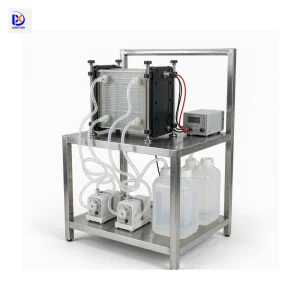
Electrodialysis Units

Laboratory electrodialysis unit for desalting and concentrating process liquors: 10–40 membrane pairs, 10–50 mA/cm², up to 99.8% salt removal on bench scale.

Electrodialysis moves ions through membranes under an electric field, so it removes salt without removing water — the opposite of evaporation. The laboratory unit in this section runs 10 to 40 membrane pairs at 10–50 mA/cm² and reaches up to 99.8% salt removal at bench scale.

Where it fits

Desalting a process stream without evaporating it. When the salt is the impurity and the water is the product, electrodialysis is far cheaper than boiling the water off. That is the acid recovery and rinse-water recycle case.

Concentrating a salt for disposal or recovery. The concentrate compartment collects the ions; the diluate leaves clean. Both streams are usable.

Closing a water balance. A plant that cannot discharge cannot keep buying fresh water either. Electrodialysis is one of the few units that produces a recyclable water stream and a small brine rather than a large dilute effluent.

How the bench unit is specified

ParameterRangeWhat it decides
Membrane pairs10–40Salt removal per pass, and stack voltage
Current density10–50 mA/cm²Transfer rate against energy consumption and scaling risk
Salt removal (bench)up to 99.8%Whether a single pass or a batch recycle is needed

Operating notes

Limiting current density is the cliff edge. Above it, water splits and the stack fouls. The usable window is below the limiting current density for your feed concentration, which is why the bench unit is run as a current-density sweep, not at one setting.

Scaling happens in the concentrate. Calcium and sulphate concentrate until they precipitate on the membrane. Polarity reversal and antiscalant dosing are the two standard defences, and both need testing on your liquor.

Energy scales with salt removed, not volume treated. Report kWh per kilogram of salt removed, not per cubic metre — otherwise two units at different feed strengths cannot be compared.

Membranes are consumables. Fouling, oxidation and mechanical creep all shorten life. Budget for replacement per square metre per year and it becomes an ordinary operating cost line.

Common questions

Electrodialysis or reverse osmosis?

RO removes water and leaves the salt behind; ED removes the salt and leaves the water. For high-salinity streams, ED avoids the osmotic pressure limit that makes RO expensive.

Can it recover acid?

Yes, with the right membrane arrangement — that is one of the main reasons hydrometallurgical projects look at ED at all.

Prices are quoted per project — every unit is sized for your duty. The first reply carries a budget band and a lead time, within one business day.

Showing the single result

  • Laboratory Electrodialysis Desalination Unit

    Laboratory Electrodialysis Desalination Unit

    PriceOn request

    Laboratory electrodialysis unit for desalting and concentrating process liquors: 10–40 membrane pairs, 10–50 mA/cm², up to 99.8% salt removal on benchmark duty, 30–60 V DC, built to produce the limiting-current and energy data a stack design needs.

+86 19386680947
Request a QuoteWhatsApp