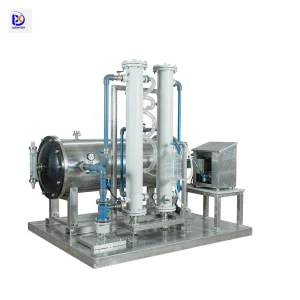
Membrane Filtration Units

Laboratory cross-flow membrane unit for clarification, concentration and salt separation: ceramic or polymeric membranes from 1 kDa to 1.4 µm at 1–5 bar.

Cross-flow membrane filtration separates by size while the feed keeps moving, which is why it can concentrate a stream that would blind a dead-end filter in minutes. The laboratory unit in this section runs ceramic or polymeric membranes from 1 kDa to 1.4 µm at 1 to 5 bar.

Where a membrane belongs in a hydrometallurgical flowsheet

Clarification ahead of a polishing step. When a bag or cartridge filter change-out frequency becomes the bottleneck, a membrane takes the fine solids out continuously and sends a clean permeate forward.

Concentration without evaporation. If the goal is to raise a metal concentration before precipitation or crystallization, a tight membrane removes water at ambient temperature — no steam, no scaling from boiling.

Salt separation. Nanofiltration splits mono- from divalent ions, which is how a chloride or sulphate balance is sometimes closed without adding a reagent.

How the unit is specified

ParameterRange on this unitWhat it decides
Membrane materialCeramic or polymericChemical compatibility, cleaning regime, life
Cut-off1 kDa to 1.4 µmWhat passes and what is retained
Operating pressure1–5 barFlux, and whether the membrane compacts

Ceramic for aggressive and hot; polymeric for tight cut-offs. Ceramic membranes tolerate acid, alkali, oxidants and steam-in-place cleaning, and they backflush hard. Polymeric membranes go to finer cut-offs and cost less, but the cleaning envelope is narrower.

Operating notes

Flux decline is the measurement. Record permeate flux against time at constant pressure and temperature. A curve that flattens is concentration polarization you can live with; a curve that keeps falling is fouling that needs a cleaning cycle or a different membrane.

Cross-flow velocity is the anti-fouling control. Higher velocity scours the surface and costs pumping energy. The right value is the one that keeps flux stable at your solids level.

Clean by the foulant, not by habit. Organics need caustic and surfactant; scales need acid; biofilms need oxidant. A generic clean is how membranes die young.

Concentration factor sets the campaign length. Decide the volume reduction you need before starting, then run to it — membranes concentrate until the viscosity or the solids stop them, and predicting where that happens on your liquor is what the lab unit is for.

Common questions

Membrane or centrifuge for clarification?

Membrane gives a cleaner permeate and no moving parts in the separation zone; a centrifuge handles much higher solids and gives a dewatered cake. Membrane for polish and concentration, centrifuge for bulk solids.

What cut-off should I start with?

Start one step coarser than the species you want to retain. A tighter membrane than the duty needs costs flux and cleaning time for no gain.

Prices are quoted per project — every unit is sized for your duty. The first reply carries a budget band and a lead time, within one business day.

Showing the single result

  • Laboratory Cross-Flow Membrane Filtration Unit

    Laboratory Cross-Flow Membrane Filtration Unit

    PriceOn request

    Laboratory cross-flow membrane unit for clarification, concentration and salt separation: ceramic or polymeric membranes from 1 kDa to 1.4 µm, 1–5 bar transmembrane pressure, 1–4 m/s cross-flow, 0.1–0.5 m² of area on a 5–30 L loop.

+86 19386680947
Request a QuoteWhatsApp