Lab-Scale Copper Electrowinning Cell
PriceOn request — quoted against your specification
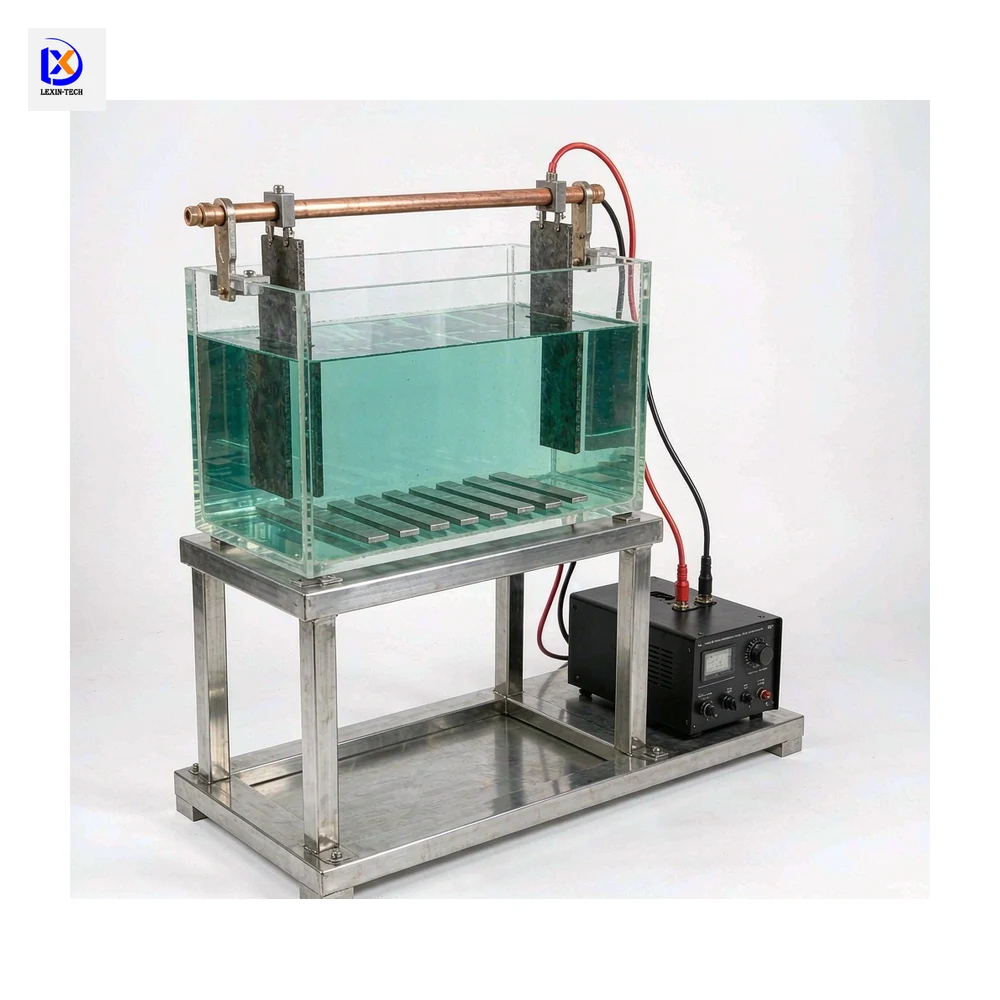
Lab-scale copper electrowinning cell with anode and cathode assembly, for current-efficiency, cathode quality and energy-consumption tests on real electrolyte.
- Built to order
Engineered against your feed assay and throughput - Bench & pilot tested
Sample testing before the flowsheet is frozen - Export documented
Pre-tested, skid-mounted, documented for customs - EN / ES / RU / AR
Technical support in four languages
A lab-scale copper electrowinning cell is the bench rig that turns an electrolyte composition into the three numbers a tankhouse design needs: current efficiency, cathode quality and energy consumption per tonne of copper.
Where it fits in the flowsheet
Electrowinning is the last step and the one that decides whether the whole circuit makes saleable metal. Every upstream decision — how much iron reports to the electrolyte, how much chloride, how much organic carry-over — shows up here as a current efficiency figure or a cathode that will not strip cleanly. A bench cell is how those effects are measured before they are discovered in a tankhouse.
The three measurements that matter
Current efficiency: the fraction of the charge that actually deposits metal rather than reducing something else or evolving hydrogen. Cathode quality: nodulation, dendritic growth, inclusions and adherence — a cathode that assays well but will not strip is a failed test. Energy consumption: cell voltage divided by current efficiency, which is the number that decides the power bill and therefore the project.
Reading the configuration
- Cell body and electrolyte volume — sized so the cathode area and the volume give a realistic current density without depleting the electrolyte in an hour. Too small a cell turns every test into a depletion experiment.
- Anode and cathode assembly — the electrode spacing, the cathode surface and the current distribution across it. Contact resistance at the hanger is the most common cause of a bad result that gets blamed on chemistry.
- DC supply and current control — current density is a set point, not an outcome. Regulation matters more than maximum output.
- Temperature control — tankhouse electrolyte runs warm and the temperature changes both conductivity and deposit morphology. A cell without temperature control measures the room, not the process.
- Materials — acid sulphate or chloride electrolyte, with the anode and cathode chosen accordingly: lead alloy for sulphate duty, titanium-based for chloride.
Typical duty
Current-efficiency curves against current density and impurity level, cathode morphology studies, additive and smoothing-agent screening, and the electrolyte quality limits that feed back into the purification circuit design.
What to send us
The electrolyte analysis, target current density, cathode size, temperature and whether the duty is sulphate or chloride. Cell volume, electrode arrangement and rectifier specification follow from those — and the answer changes completely between the two chemistries.
Specifications
| Working Volume | 20 L, 50 L, 100 L benchtop sizes (other volumes on request) |
|---|---|
| Cell Material | Transparent PMMA (acrylic) or clear PVC tank, solvent-welded seams, open top rim |
| Electrode Configuration | Parallel plate set: Pb-Sn-Ca / Pb-Ag anodes and SS316 starter cathodes, 20-40 mm electrode gap |
| Cathode Plate Material | SS316L or titanium permanent cathode plates with copper hanger bars (matching our Cathode Plate series) |
| Busbar and Contacts | Top copper busbar with insulated edge clamps, single-edge plate contact |
| Rectifier | Benchtop DC rectifier, 0-20 V / 0-50 A; typical current density 150-300 A/m2 (to be confirmed by test work) |
| Temperature Range | Ambient to 60 deg C; optional immersion heater or cooling coil |
| Electrolyte System | Copper sulfate electrolyte with free H2SO4 100-180 g/L, green-blue solution as illustrated |
| Applicable Systems | Cu, Zn, Ni, Co electrowinning and electrorefining bench test work; chloride media require DSA anodes - consult factory |
| Wetted Materials | Acrylic/PVC wetted parts suitable for sulfate systems; fluoride- or chloride-bearing electrolytes require CPVC, PTFE-lined or titanium construction |
Values are the documented specifications for this model. Final dimensions are confirmed on the approved drawing before production.
Related products
-
-
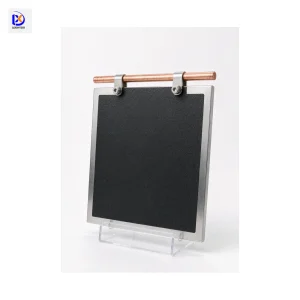
Laboratory MMO-Coated Titanium Anode Plate
PriceOn request — quoted against your specification -
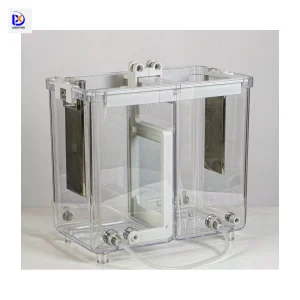
Lab-Scale Diaphragm Electrolytic Cell
PriceOn request — quoted against your specification -