Lab-Scale Spray Dryer for Metal Salt Powders
PriceOn request — quoted against your specification
Lexin-tech is professional customized China Lab-Scale Spray Dryer for Metal Salt Powders manufacturers,supplier and factory, specialized in providing customized Lab-Scale Spray Dryer for Metal Salt Powders in stock with wholesale price. For quotation, contact us now.
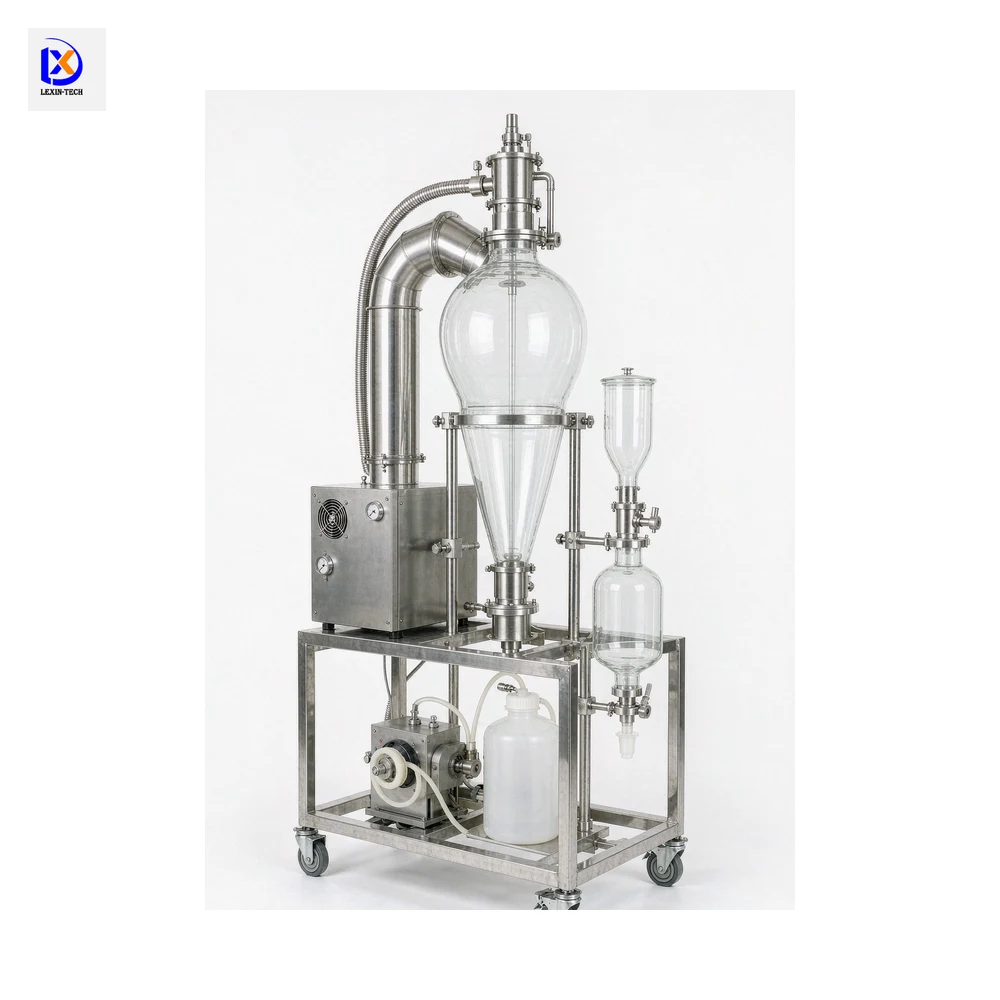
Spray drying turns a purified pregnant or strip liquor into a free-flowing salt powder in one step: the solution is atomised into a hot air stream, the solvent flashes off and the salt crystallises as spherical particles while it is still falling. For a hydrometallurgical flowsheet this is the fastest way to produce the saleable sulphate or chloride product and to see, in grams, what the crystalliser would have to make in tonnes.
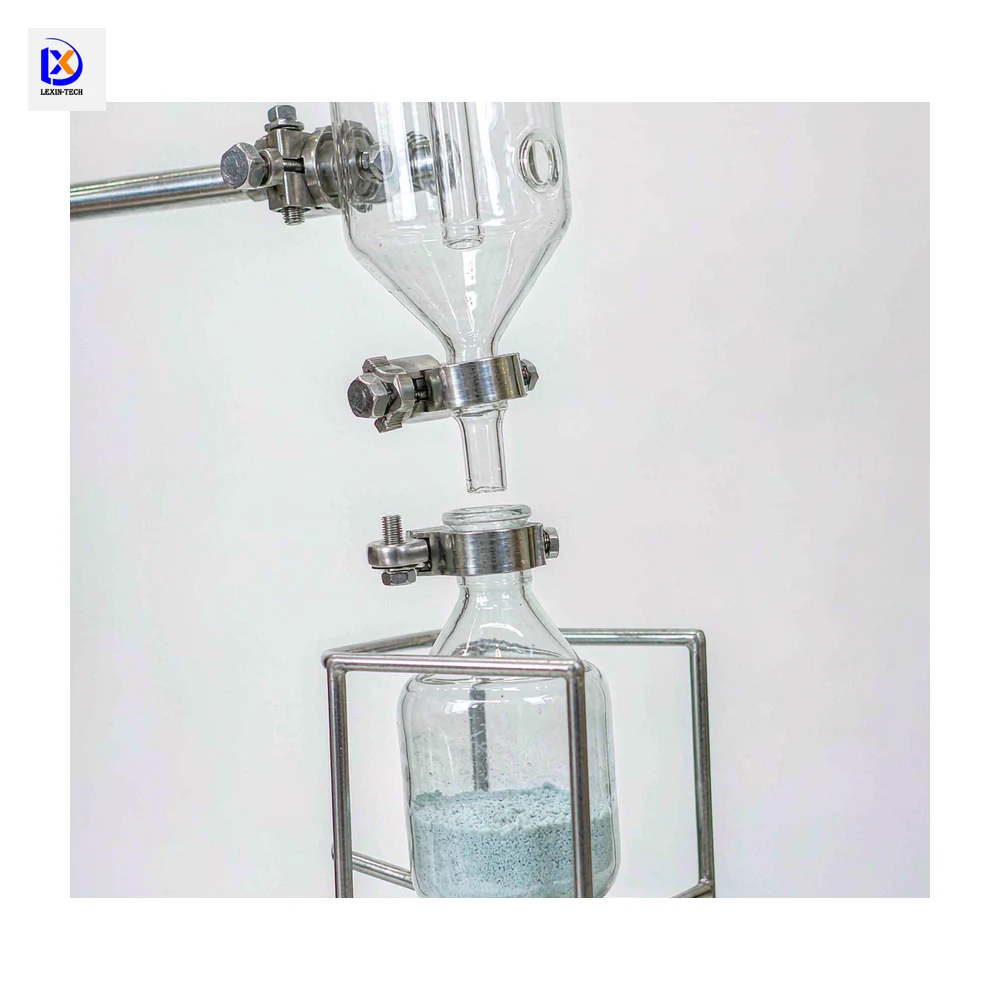
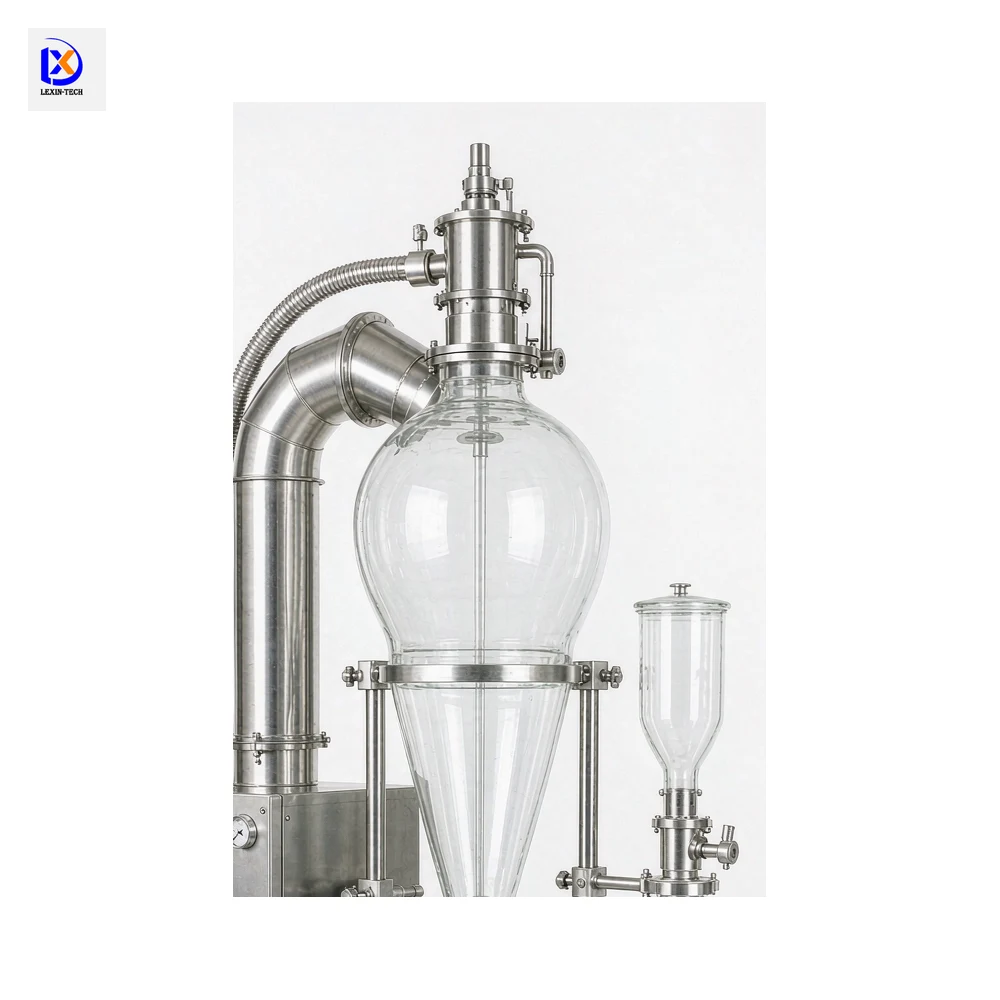
The unit is built around a borosilicate glass chamber, so the spray cone, wall deposition and any caking are visible during a run. Inlet temperature, atomising air pressure, feed rate and air flow are all adjustable, which is what determines particle size, bulk density and residual moisture. Powder is recovered in a glass cyclone and 2 L bottle, which is enough for sizing, XRD and assay work.
- Built to order
Engineered against your feed assay and throughput - Bench & pilot tested
Sample testing before the flowsheet is frozen - Export documented
Pre-tested, skid-mounted, documented for customs - EN / ES / RU / AR
Technical support in four languages
Lexin-tech is professional customized China Lab-Scale Spray Dryer for Metal Salt Powders manufacturers,supplier and factory, specialized in providing customized Lab-Scale Spray Dryer for Metal Salt Powders in stock with wholesale price. For quotation, contact us now.
Spray drying turns a purified pregnant or strip liquor into a free-flowing salt powder in one step: the solution is atomised into a hot air stream, the solvent flashes off and the salt crystallises as spherical particles while it is still falling. For a hydrometallurgical flowsheet this is the fastest way to produce the saleable sulphate or chloride product and to see, in grams, what the crystalliser would have to make in tonnes.
The unit is built around a borosilicate glass chamber, so the spray cone, wall deposition and any caking are visible during a run. Inlet temperature, atomising air pressure, feed rate and air flow are all adjustable, which is what determines particle size, bulk density and residual moisture. Powder is recovered in a glass cyclone and 2 L bottle, which is enough for sizing, XRD and assay work.
Specifications
| Drying Chamber | Borosilicate glass 3.3, 150 mm ID x 500 mm cylindrical section with 60 degree glass cone |
|---|---|
| Atomizer | Two-fluid nozzle, 0.5-2.0 mm orifice, compressed air 0.1-0.5 MPa, adjustable air cap |
| Inlet Air Temperature | 30-220 C, PID controlled within +/-2 C, type K thermocouples at inlet and outlet |
| Feed Rate | 50-1500 mL/h peristaltic pump with silicone tubing, 5 L feed bottle |
| Powder Recovery | Glass cyclone with 2 L glass collection bottle; recovery for coarse sulphate salts typically 80-90% (to be confirmed by test work) |
| Air Flow | 1-5 m3/h variable, centrifugal blower with air-flow indication |
| Wetted Materials | Borosilicate glass 3.3, 316L stainless steel, PTFE and silicone; stainless steel frame on castors |
| Material Limits | Aqueous sulphate and chloride salt solutions, pH 1-12, up to 150 g/L H2SO4. Fluoride-bearing or strongly scaling liquors require a PTFE-lined chamber and cyclone |
| Typical Output | 50-500 g/h dry powder depending on solids content and inlet temperature (to be confirmed by test work) |
| Utilities | 220 V / 50 Hz single phase, 3 kW heater; compressed air 0.5 m3/h at 0.4 MPa |
Values are the documented specifications for this model. Final dimensions are confirmed on the approved drawing before production.
Related products
-
-
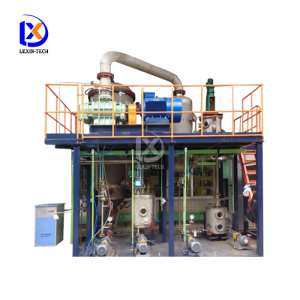
Выпарная кристаллизационная установка MVR
PriceOn request — quoted against your specification -
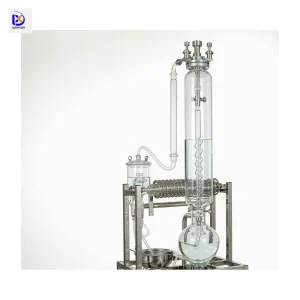
Лабораторный испаритель с падающей плёнкой
PriceOn request — quoted against your specification -
Evaporador de película descendente a escala laboratorio
PriceOn request — quoted against your specification