O/A Ratio and Extraction Stage Calculator
Enter your aqueous feed flow, distribution coefficient and the O/A ratio you are considering. The calculator applies the Kremser equation to a counter-current circuit with fresh solvent and returns the extraction factor, the theoretical stages needed to hit your recovery target, and the loaded organic concentration — so you can check whether the organic is being pushed beyond its loading capacity before you commit to a stage count.
Results
The results appear here and update as you type. Each result is followed by the conditions under which it holds.
How to use it
- Measure D at your operating pH
Run shake-out tests across the pH range and record the organic-to-aqueous concentration ratio at equilibrium. Do not reuse a literature D from a different pH.
- Choose an O/A ratio to test
Start from the concentration factor you need: the organic flow follows from the metal mass balance and the organic's loading capacity.
- Read the extraction factor
E below about 3 means the stage count rises steeply for each extra point of recovery. E above about 10 means recovery is no longer very sensitive to stage count.
- Check the stage count against the loaded organic
If the loaded organic concentration exceeds the isotherm plateau, the circuit cannot hold the metal and the O/A ratio must rise.
- Confirm at pilot scale
Theoretical stages assume 100% stage efficiency. A mixer-settler typically achieves 90% or better, so round the stage count up and allow a spare stage.
Formulas used
E = D × (O/A)                                     extraction factor
φ = 1 − X_N/X_0 = (E^(N+1) − E) / (E^(N+1) − 1)    Kremser, counter-current, fresh solvent
N = ln((E − φ)/(1 − φ)) / ln(E) − 1               solved for N  (E ≠ 1)
N = φ / (1 − φ)                                   special case E = 1
X_N = X_0 × (1 − φ)                               raffinate concentration
Y_organic = (X_0 − X_N) × Q_aqueous / Q_organic   loaded organic concentration
Assumptions & applicability
- Counter-current circuit with fresh (fully stripped) solvent entering the last stage — no metal in the incoming organic.
- Immiscible phases, constant volumetric flows across the circuit (no significant mutual solubility or volume change on mixing).
- D is treated as constant. In reality D varies with metal loading and pH, so a system operating near the isotherm plateau will need more stages than this estimate.
- Theoretical stages only. Divide by your measured stage efficiency — 90% per stage is typical for a well-designed mixer-settler — to get actual stages.
- Single solute, no competing extraction of impurities, no crud, no third phase.
FAQ
Why does my circuit need more stages than this calculator says?
Three usual reasons: D falls as the organic loads up (the isotherm flattens), stage efficiency is below 100%, or the mixer is not reaching equilibrium. Measure the aqueous concentration leaving each stage — if it stops changing between stages, the chemistry is limiting; if it changes a lot, the mixing is.
What O/A ratio should I start with?
Set it from the concentration factor you need and the organic's loading capacity, not the other way round. A low O/A ratio keeps the settler small but demands more stages and pushes the organic towards saturation; raising the ratio buys stages back at the cost of a larger settler and more organic inventory.
Is a higher D always better?
For extraction, usually — but a very high D makes stripping harder, because the reverse reaction needs the metal to leave the organic. Systems with high D in both directions do not exist, so the extractant's pH window is chosen to give good extraction while still allowing clean stripping.
Terms used above
Equipment sized with this calculation
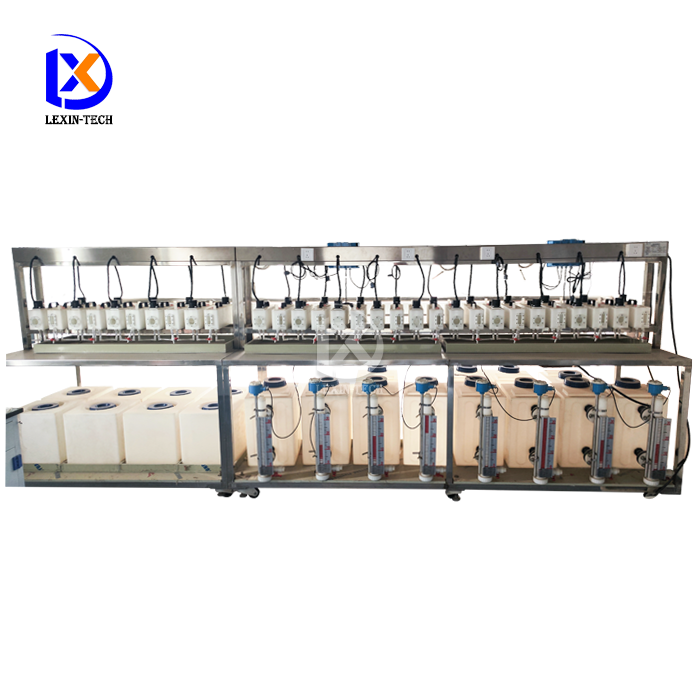
PP Mixer Settler
9 Specifications · mixer settler
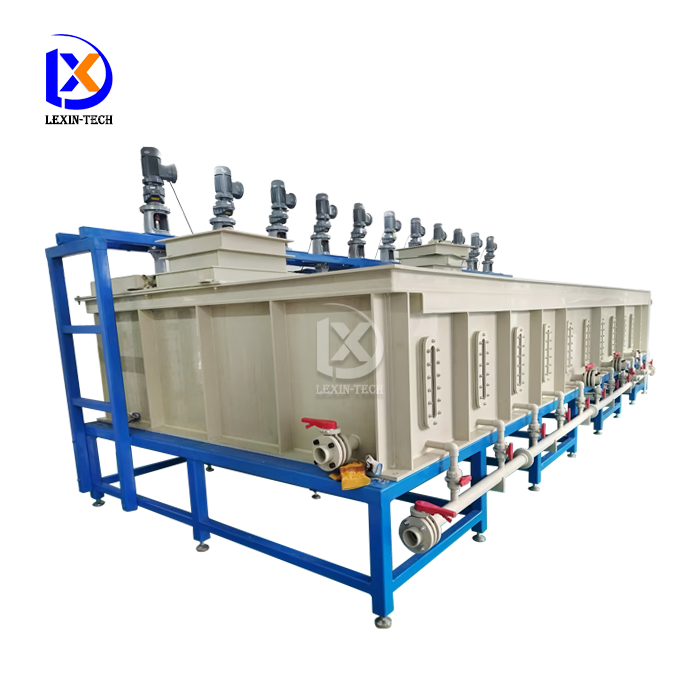
Pilot Scale Mixer Settler
8 Specifications · mixer settler
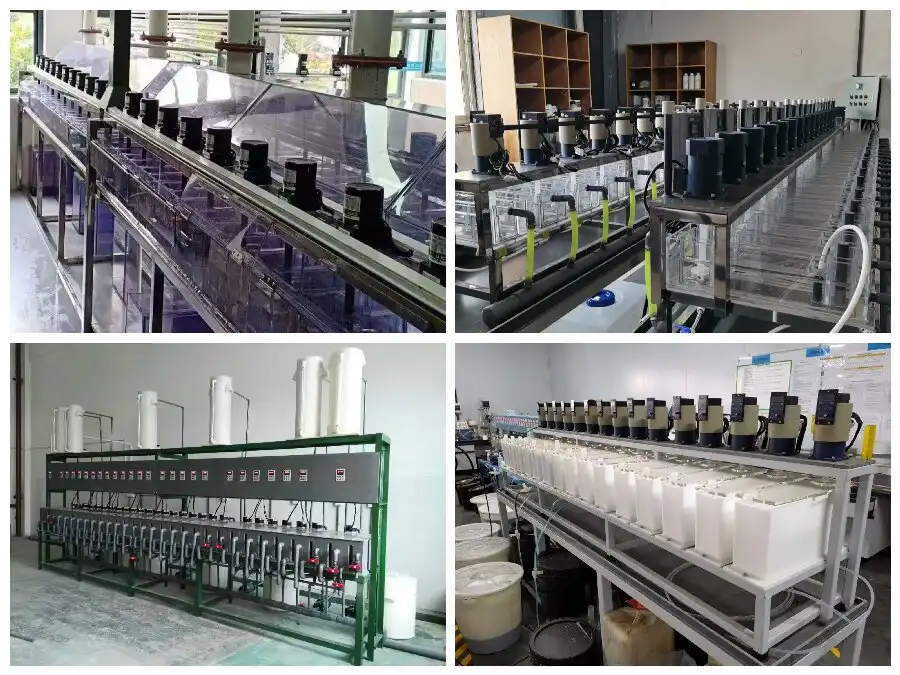
Lab Scale Mixer Settler
8 Specifications · mixer settler
Further reading
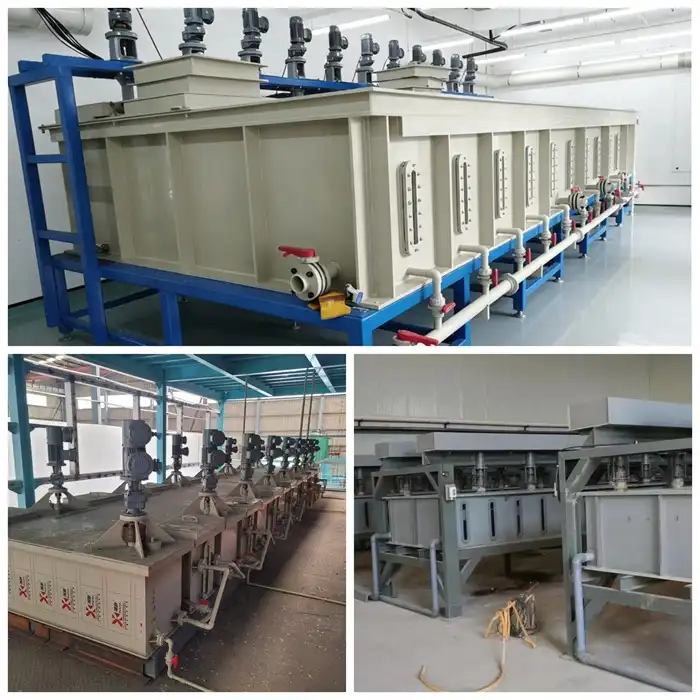 KBHow Do Agitation Methods Affect a Pilot-Scale Mixer-Settler Efficiency?how-do-agitation-methods-affect-a-pilot-scale-mixer-settler-efficiency
Get this sized against your own material
The calculator returns a pre-feasibility number. For a quotation we need the feed assay, throughput, medium and temperature — and, where the result hinges on it, test data from your own material.
Request a sized quotation Ask an engineer a questionCalculator reference TL-O-A-RATIO-AND-STAGE-COUNT. This tool is provided for preliminary engineering estimates. Final equipment selection must be confirmed against test work on your own material and reviewed by a qualified process engineer.