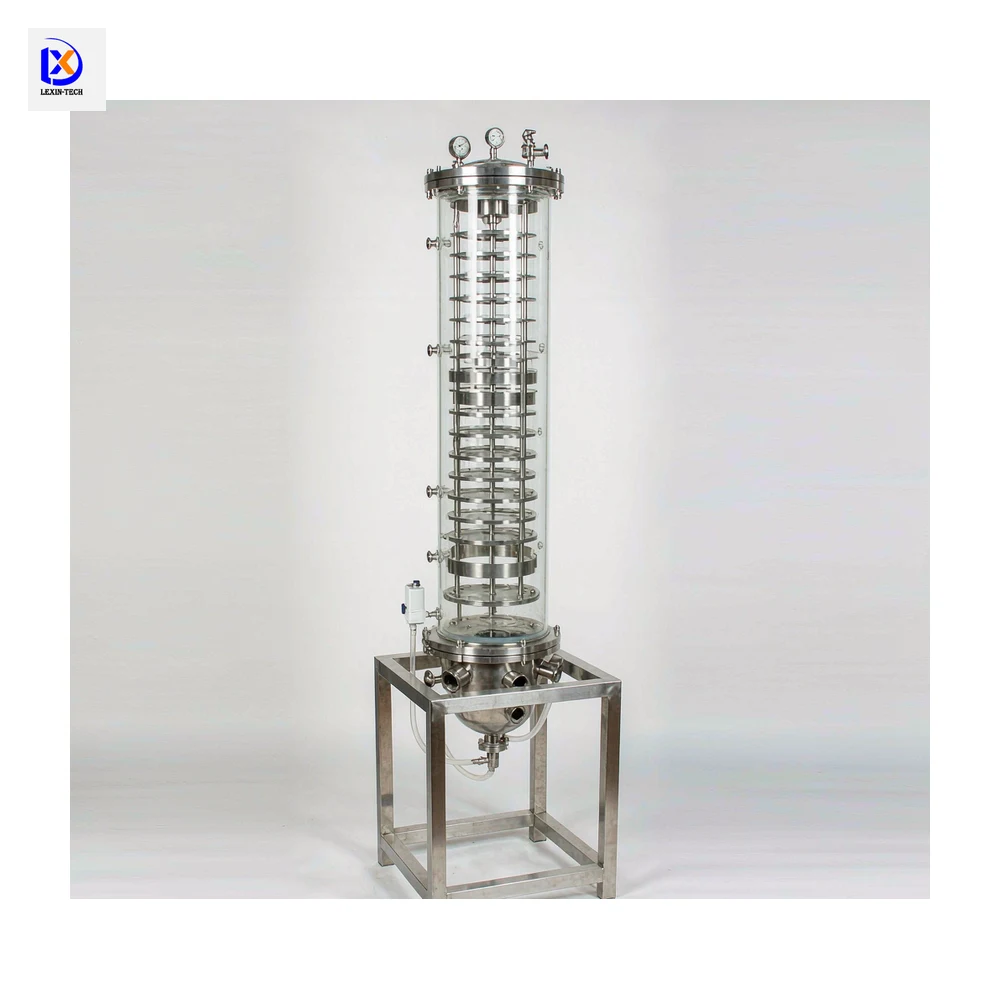
Pilot-Scale Baffle-Plate Extraction Column
PriceOn request — the first reply carries a budget band and a lead time, within one business day
Pilot baffle-plate extraction column for high-stage-count solvent extraction: 50–150 mm diameter, 1.5–3.0 m packed height, pulsed or static baffles, HETS around 0.7 m, throughput 50–90 m³/(m²·h) at flooding — compact where a mixer-settler train will not fit.
- Built to order
Engineered against your feed assay and throughput - Bench & pilot tested
Sample testing before the flowsheet is frozen - Export documented
Pre-tested, skid-mounted, documented for customs - EN / ES / RU / AR
Technical support in four languages
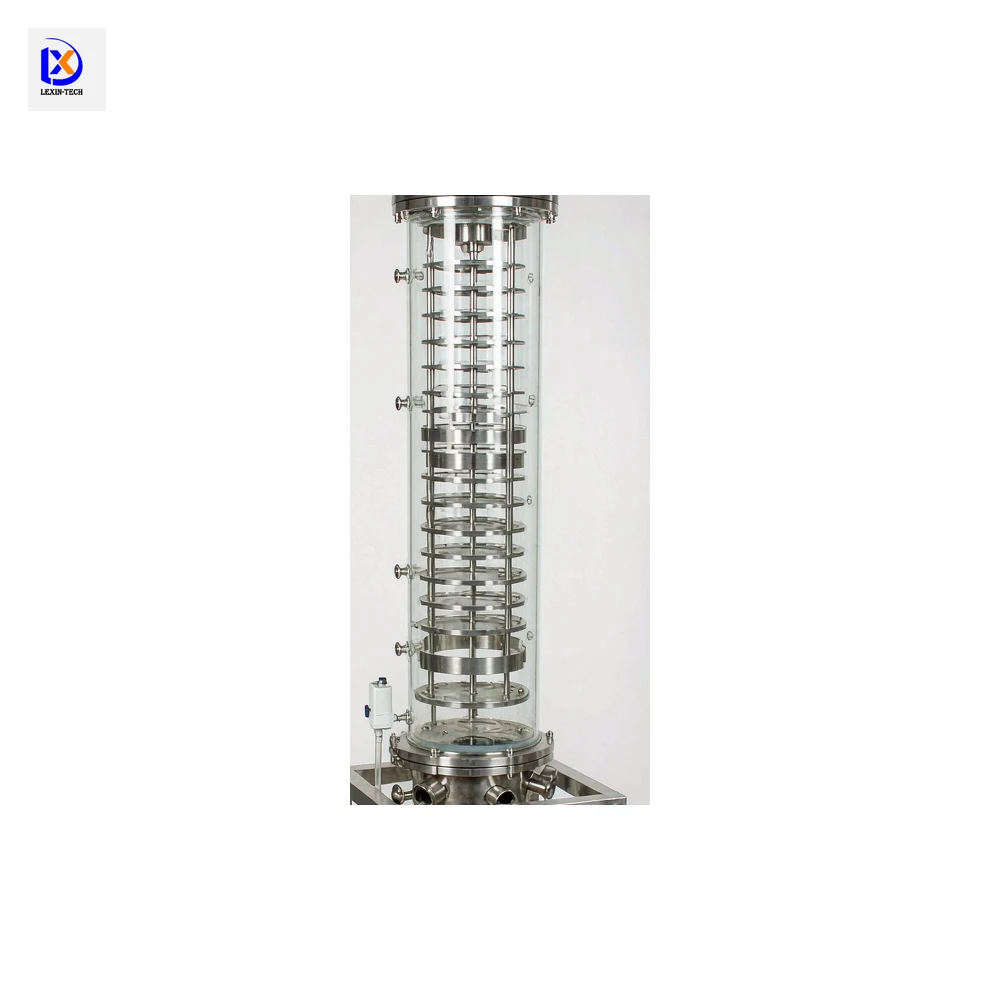
Once a flowsheet needs more than about six extraction stages, a mixer-settler train stops being a set of boxes and becomes a building. A column does the same duty in a footprint measured in centimetres of diameter, because stages are stacked vertically instead of laid out on the floor. The baffle-plate column is the version of that idea with no moving parts inside: a stack of plates forces the two phases to break up and re-coalesce as they pass, and each plate pair approximates a stage.
What the plates are doing
Each baffle presents a contraction followed by an expansion. The contraction accelerates the dispersed phase and shears the droplets; the expansion slows it and lets the droplets collide and coalesce. The cycle repeats up the column, and the net effect is a series of well-mixed contacting zones separated by coalescence zones — which is what a stage is. Because there are no agitators, there is nothing to seal, nothing to maintain inside the column, and nothing that puts shear into a system where the emulsion is the product.
Published performance on a 120 mm ring-baffle pulsed column gives a flooding velocity of about 2.3 cm/s, an equivalent stage height (HETS) of roughly 700 mm and a height of a transfer unit of 210 mm, with uranium extraction above 99.99% — figures that sit in the same range as agitated columns while offering a wider operating window.
Pulsation is the operating variable
A static baffle stack relies on the density difference and the flow to drive dispersion, which limits how hard it can be pushed. A pulsed column adds a reciprocating motion to the continuous phase, and that pulse intensity — expressed in mm/s of superficial displacement — becomes the single most important setting. Too low and the phases separate into two layers with almost no interfacial area; too high and the column back-mixes, the droplets become so small that the coalescence zones cannot clear them, and the column floods.
Laboratory work on baffle columns for zirconium–hafnium extraction shows the practical shape of that curve: extraction efficiency rises with pulse intensity up to about 10 mm/s and then falls away sharply for some baffle materials, while others keep improving. Baffle wettability matters as much as the pulse — a strongly hydrophobic PTFE baffle holds a higher dispersed-phase holdup but is harder to make droplets on, and the two effects do not cancel.
Where a column wins, and where it does not
It wins wherever the stage count is high, the inventory of solvent has to be small, the liquids are hazardous and containment matters, or the floor area is simply not available. Rare earth separation, zirconium–hafnium, nuclear fuel reprocessing and some cobalt–nickel purification trains are the classic cases.
It loses wherever the feed carries solids, because there is no way to remove crud from inside a column without stopping it, and wherever the kinetics are slow: a column gives droplets seconds of contact, and slow mass transfer needs the residence time that only a mixer-settler provides. It also loses on turndown — a column that is designed for a flow operates in a narrow band around it.
What a pilot campaign must measure
- Flooding velocity for the intended phase ratio, then design at 50–70% of it.
- HETS against pulse intensity and against flow ratio, which together give the height and the operating window.
- Stage count achieved against the theoretical requirement from the isotherm — a column that meets the recovery but at twice the predicted height is telling you something about the baffle design.
- Entrainment of one phase in the other at both outlets, since that is the number that decides whether a coalescer is needed downstream.
- Pressure drop and interface control stability over a long run, because a column that drifts is a column that floods overnight.
Specifications
| Column diameter | 50 – 150 mm |
|---|---|
| Packed height | 1.5 – 3.0 m |
| Baffle spacing | 25 – 50 mm |
| Baffle material | PP, PVDF, PTFE or ceramic (HF-bearing systems) |
| Pulse amplitude / frequency | 6 – 25 mm / 0.5 – 2 Hz |
| Pulse intensity | up to 10 – 20 mm/s superficial displacement |
| Throughput | flooding 1.5 – 2.5 cm/s (54 – 90 m³/m²·h); design at 50 – 70% |
| HETS | ≈ 0.3 – 1.0 m, system-dependent |
| Stages achievable | 5 – 20 in a 3 m column |
| Operating temperature | to 60 – 80 °C |
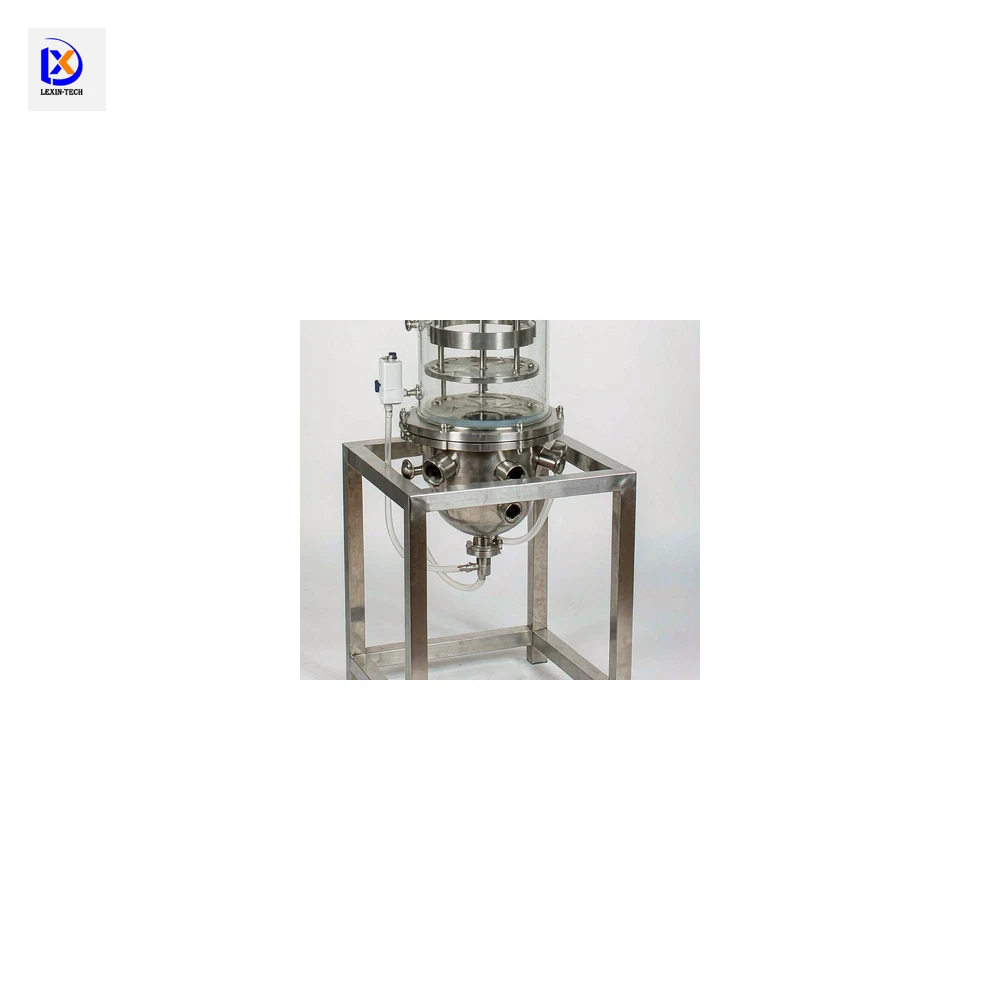
| Wetted materials | Borosilicate glass or PP column, PTFE gaskets, 316L flanges |
| Instrumentation | Interface level, differential pressure, pulse displacement, flow per phase |
Values are the documented specifications for this model. Final dimensions are confirmed on the approved drawing before production.
Frequently asked questions
Column or mixer-settler?
Column for high stage counts, small solvent inventory and a tight footprint; mixer-settler for solids tolerance, slow kinetics, high turndown and operability by a normal shift team. Above about six stages the column usually wins on capital and floor area; below that the mixer-settler usually wins on simplicity.
How do I know the pulse is right?
By measuring HETS against pulse intensity. The curve has a minimum: below it the phases are under-dispersed, above it back-mixing and entrainment dominate. Set the operating point slightly below the minimum, so that a small drift does not put you on the wrong side of the curve.
Can it handle crud?
Not well, and pretending otherwise is how columns get abandoned. Solids accumulate at the baffles, the interface rises, and the only fix is to stop and clean. A feed with more than trace solids needs filtration upstream — which is a disc stack or a coalescer, not a strainer.
What height do I need for my stage count?
Multiply the measured HETS by the number of theoretical stages and add the decanting sections at each end, typically 0.5–1.0 m in total. A pilot that only measures recovery will under-predict the height, because recovery can be met with a taller effective bed and a worse HETS.
Related products
-
Pilot-Scale Pulsed Sieve-Plate Extraction Column
PriceOn request — the first reply carries a budget band and a lead time, within one business day -
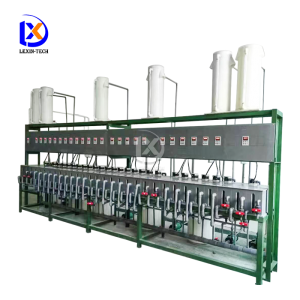
PVC Mixer Settler
PriceOn request — the first reply carries a budget band and a lead time, within one business day -
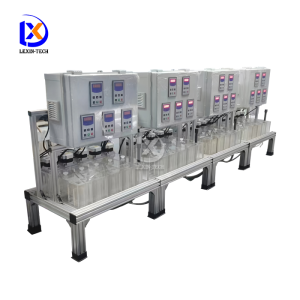
Transparent PMMA Mixer Settler
PriceOn request — the first reply carries a budget band and a lead time, within one business day -
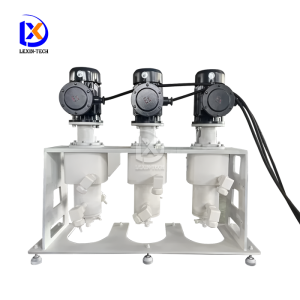
50mm Rotary Drum Centrifugal Extractor
PriceOn request — the first reply carries a budget band and a lead time, within one business day