Ion Exchange Units

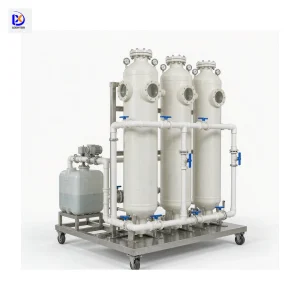
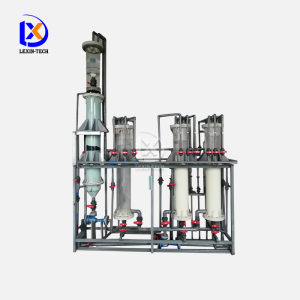
PMMA and PP ion exchange units with 100–600 mm columns for base-metal recovery and impurity removal, plus a pilot lead–lag column train with in-place regeneration.

An ion exchange unit is a column of resin that captures a metal or an impurity from a dilute liquor and releases it again on regeneration. This range covers the two things a project needs: a visible-bed column for method work, and a lead–lag train that runs the full load–wash–elute cycle at pilot scale.

What the range covers

UnitColumnConfigurationDuty
PMMA Ion Exchange Unit100–600 mm acrylic columnsMetering or gear pump feedVisible resin bed for metal recovery from dilute liquors
PP Ion Exchange Unit100–600 mm PP columnsMetering or gear pump, electromagnetic or float flowmeterBase-metal recovery and impurity removal
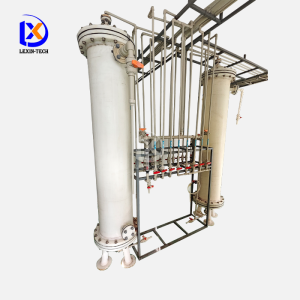
Pilot Lead–Lag IX Column Train3 columns, 50–150 mm dia, 760–1,500 mm bed depthIn-place regeneration, 2–20 BV/h serviceFull-cycle pilot work: loading, washing, elution, rinse

Why the transparent column first

Because the failure modes are all visible. Channeling, resin expansion on backwash, resin loss to the screen, colour band movement during elution — on an acrylic column you see them. On a steel column you infer them from assays two days later. For method development, that visibility is worth more than pressure rating.

Then move to the train. A single column tells you the resin capacity. A lead–lag train tells you the thing that actually sets operating cost: how many bed volumes you get before breakthrough, and how much eluant the regeneration consumes.

The four numbers that decide an IX circuit

1. Bed volumes to breakthrough. Capacity in grams per litre of resin divided by the feed concentration, discounted for kinetics. This is what sizes the column.

2. Flow rate in BV/h. Too fast and the mass transfer zone grows until it exits the bed before the resin is loaded. The 2–20 BV/h window on the pilot train is there so you can find the shoulder on your own resin.

3. Eluant consumption per cycle. The operating cost lives here, not in the resin price.

4. Resin life. Osmotic shock, oxidation and fouling kill resin slowly. A pilot train that runs dozens of cycles is how you find the real replacement interval.

Common questions

Ion exchange or solvent extraction?

IX wins on dilute liquors and on selective impurity removal; SX wins on concentrated streams and high throughput. Below roughly a gram per litre, IX usually needs less energy and less inventory.

Do I need in-place regeneration?

If you intend to run more than a handful of cycles, yes. Removing resin to regenerate it destroys the comparison between cycles and hides channeling.

Operating notes that decide the running cost

Backwash before every service cycle. Resin beds compact. A bed that is not expanded on backwash channels on the next load, and the breakthrough curve moves left without any change in chemistry.

Watch the mass transfer zone, not just the outlet assay. Sampling at three bed depths shows the zone moving. That is the difference between a planned regeneration and a breakthrough event.

Eluant strength and flow both matter. A stronger eluant at the same flow uses more reagent; a weaker one at higher flow uses more water to evaporate later. The pilot train is where that trade is measured.

Screen integrity is a maintenance item. Resin loss to the outlet is slow, invisible and expensive. Check the screen and the nozzle clearance on a schedule.

Prices are quoted per project — every unit is sized for your duty. The first reply carries a budget band and a lead time, within one business day.

Showing all 3 results

+86 19386680947
Request a QuoteWhatsApp