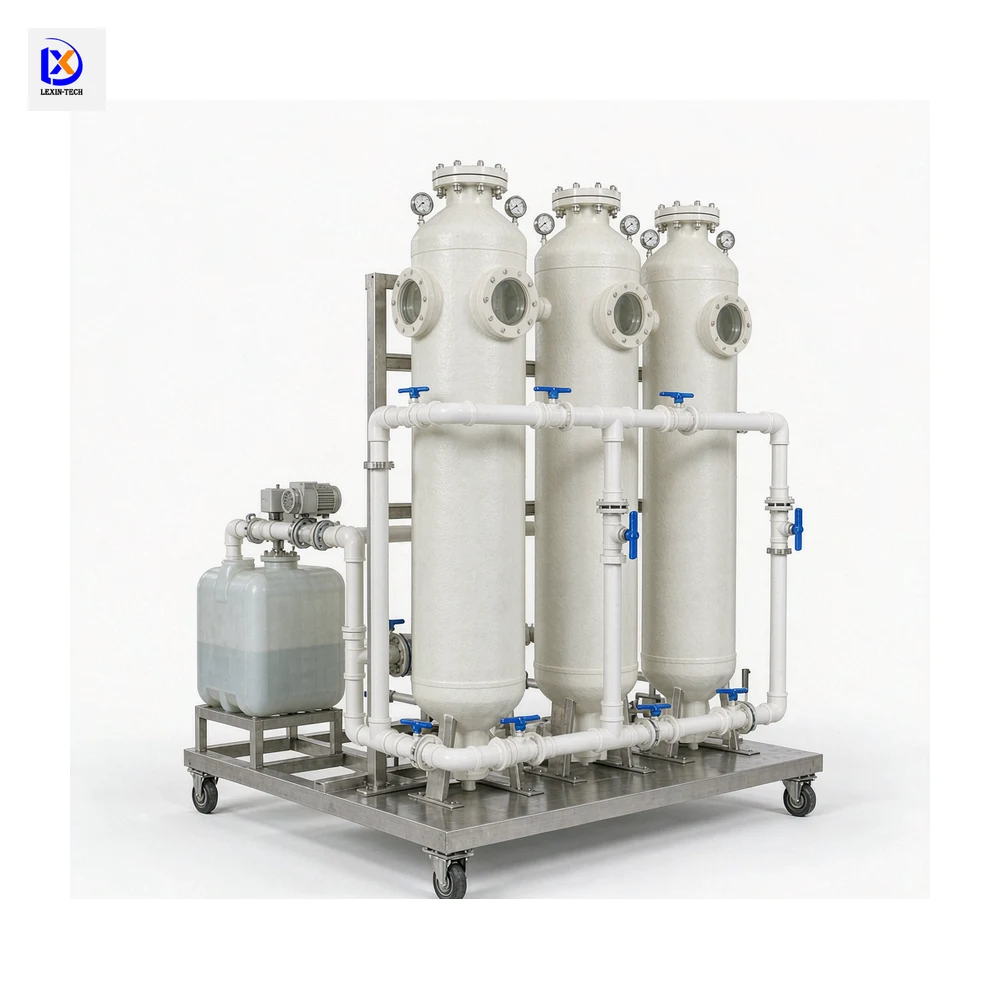
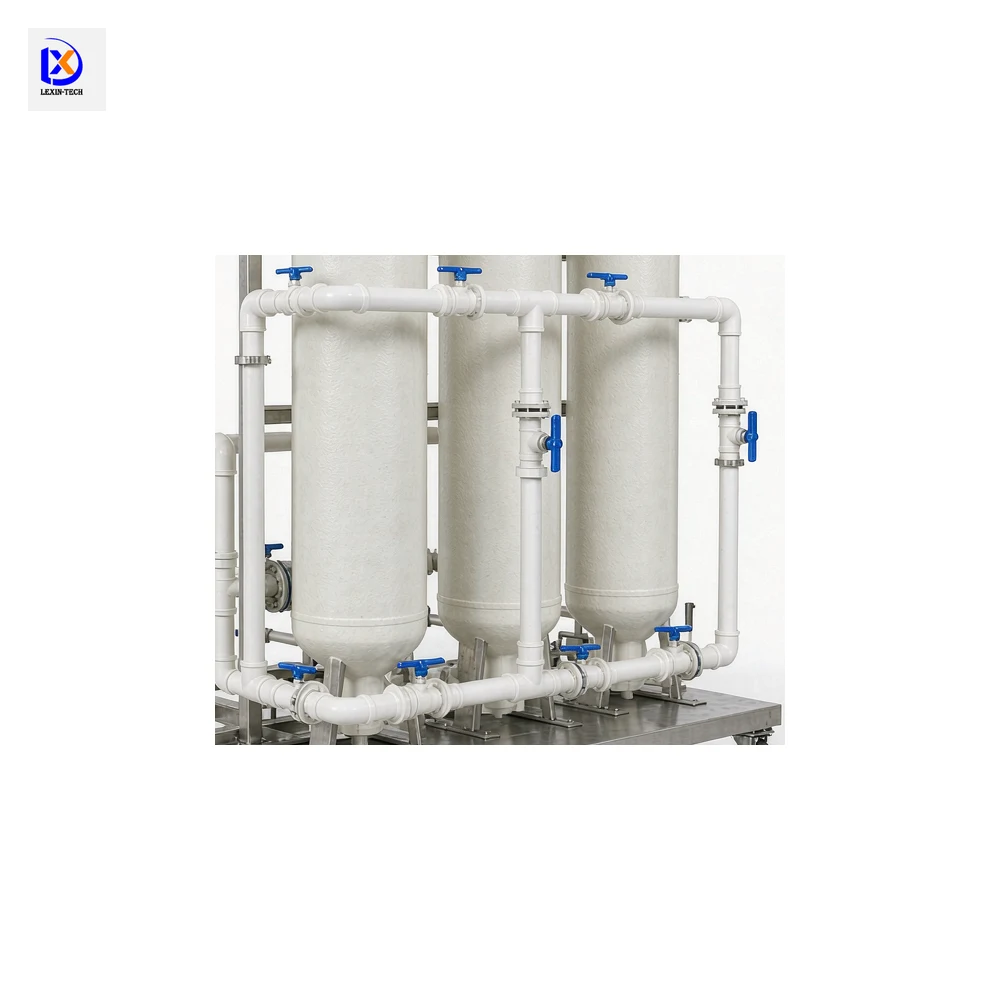
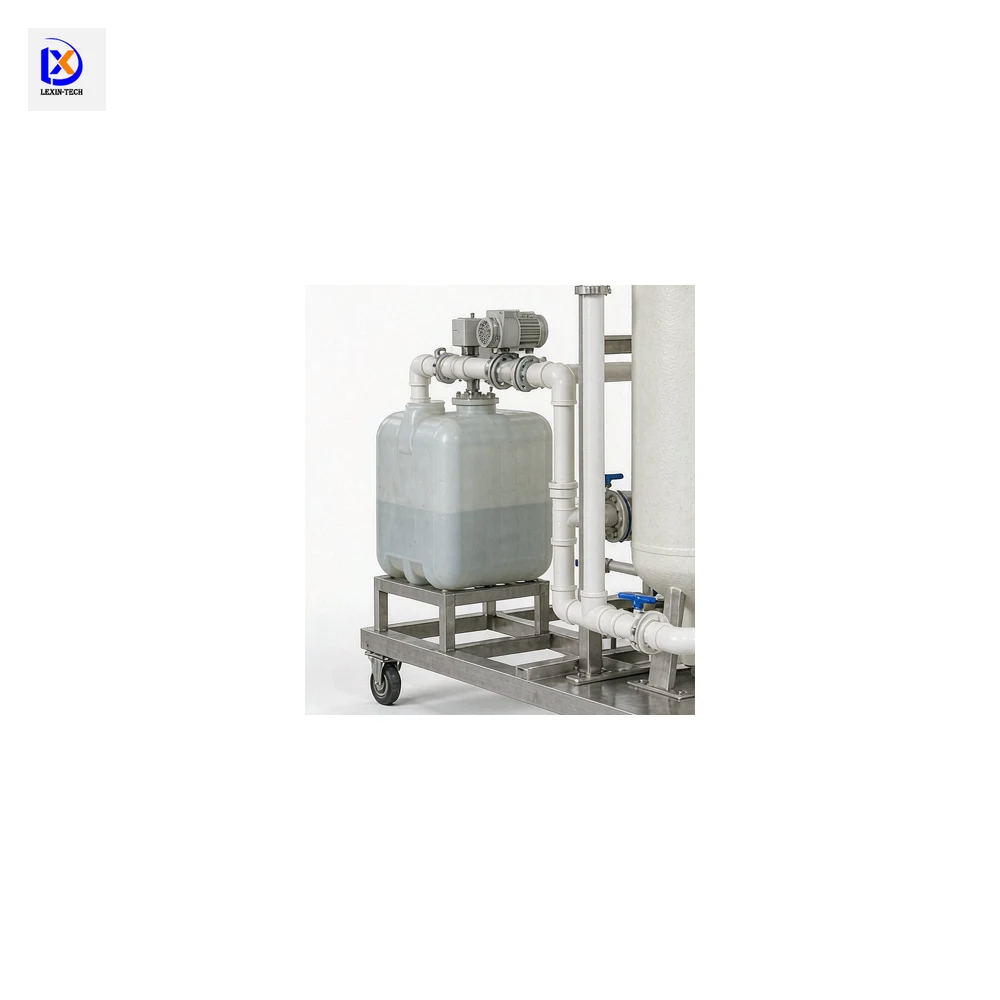
Pilot-Scale Resin Ion Exchange Column Train (Lead-Lag with Regeneration)
PriceOn request — the first reply carries a budget band and a lead time, within one business day
Pilot lead–lag ion exchange column train with in-place regeneration: 3 columns of 50–150 mm diameter, 760–1500 mm bed depth, 2–20 BV/h service flow, 2 BV/h regeneration — built to produce the breakthrough curve a production IX circuit is designed from.
- Built to order
Engineered against your feed assay and throughput - Bench & pilot tested
Sample testing before the flowsheet is frozen - Export documented
Pre-tested, skid-mounted, documented for customs - EN / ES / RU / AR
Technical support in four languages
Ion exchange is easy to demonstrate and hard to design, because almost every number that matters only appears after the resin has been run to exhaustion two or three times on the real liquor. The lead–lag train exists to do that properly: two columns in series during service, with a third either regenerating or standing by, so the circuit never stops and the resin is always used to its full capacity rather than to the point where the operator got nervous.
Why lead–lag rather than a single column
In a single-column circuit the run has to stop the moment the effluent reaches the breakpoint, which means the bottom of the bed is still loaded and the top is saturated — a poor use of resin and an interrupted flowsheet. In a lead–lag arrangement the lead column is run past its own breakthrough, because the lag column behind it is still clean and catches the leakage. When the lag column begins to show the ion, the lead is taken off-line for regeneration, the lag is promoted to lead, and the freshly regenerated column takes the lag position. Continuous service, full resin utilisation, and a guard bed that absorbs the upsets.
The consequence for design is that each column has to be sized on the breakthrough curve of the one behind it, not on its own. A train sized on single-column data will either regenerate too early or leak.
Bed depth and flow rate are not independent
Everything in ion exchange is expressed in bed volumes per hour, and the reason is that the kinetics are governed by contact time in the bed rather than by absolute flow. Published pilot guidance puts the minimum resin volume at about 375 mL and the minimum classified bed depth at 760 mm, with a service flow of 2 to 50 BV/h — 8 to 20 BV/h being the usual band, and 1 to 10 BV/h where selectivity is high and the ion is valuable. A bed shallower than about 760 mm has too few transfer units to reach the leakage specification no matter how slowly it is run, and it channels.
Regeneration is slower by design: 2 BV/h is typical, with a contact time of at least 30 minutes, a slow displacement of 1 to 2 BV to push the regenerant through without mixing it, and a fast rinse of 2 to 10 BV. Pushing regenerant faster saves time and wastes chemical, because the exchange that strips the resin is itself a mass-transfer step and it does not get faster just because the pump does.
What the pilot has to produce
- The breakthrough curve, in bed volumes to a defined leakage (usually 5% of feed assay), on the actual liquor at the actual temperature.
- Loading capacity in grams of metal per litre of resin, measured, not taken from the resin datasheet — the datasheet figure is for a pure solution.
- Regeneration efficiency: how much of the loaded metal comes off per bed volume of regenerant, and whether the capacity is restored to the same value on the third cycle as on the first.
- Pressure drop and backwash expansion at the intended flow, because a bed that cannot be backwashed 30–50% will eventually plug with fines.
- Swell between the loaded and regenerated forms. A resin that swells 20% will crack a column designed without the allowance.
The operating discipline that decides the result
Never let the bed run dry, and never introduce air. Bubbles are almost impossible to remove once they are in a resin bed, and a bed with bubbles channels for the rest of its life. Run every test to exhaustion rather than stopping halfway, because ion exchange is reversible and a paused column simply re-equilibrates with the liquor it is sitting in — which looks like premature exhaustion on the next run and is not. And run three consecutive cycles before changing any condition: the first cycle on fresh resin is rarely representative of the second or third.
Specifications
| Configuration | 3 columns: lead + lag in series, third regenerating or standby |
|---|---|
| Column diameter | 50 – 150 mm |
| Bed depth | 760 – 1,500 mm (classified) |
| Resin volume | 2 – 30 L per column |
| Service flow | 2 – 20 BV/h typical; to 50 BV/h on high-selectivity duty |
| Regenerant flow | 2 – 6 BV/h, 2 BV/h typical |
| Regenerant contact time | ≥ 30 min (15 – 60 min range) |
| Slow displacement / fast rinse | 1 – 2 BV / 2 – 10 BV |
| Backwash expansion | 30 – 50% of bed depth |
| Maximum pressure | 2 bar (glass or PP column) |
| Wetted materials | PP, PVC or FRP column; 316L or PTFE internals; EPDM / FKM seals |
| Instrumentation | Flow totaliser, pressure drop, pH and conductivity, sampling ports at 3 bed heights |
Values are the documented specifications for this model. Final dimensions are confirmed on the approved drawing before production.
Frequently asked questions
How much resin do I need for a pilot?
Enough for a bed of at least 760 mm in a column of at least 50 mm diameter, which lands around 1.5–2 L per column. Going smaller saves liquor but loses the bed depth that makes the result scalable, and a short bed will mislead you on leakage.
How many bed volumes should a run last?
It depends entirely on the feed assay and the resin capacity, and that is exactly what the pilot is for. As a sanity check: capacity in g/L multiplied by resin volume, divided by the metal load per litre of feed, gives the theoretical bed volumes — a measured figure far below that means kinetics or fouling, not capacity.
Can the same train run a different resin?
Yes, and it should: screening three resins on the same feed is the most valuable thing a three-column skid does. Change one variable at a time and run three cycles per resin before comparing.
Why does the second cycle always look worse?
Usually because the first cycle was run on virgin resin in a form that does not match the feed, or because regeneration was incomplete. Check the regenerant volume and contact time before blaming the resin. If the third cycle matches the second, the resin is fine and the first was the outlier.
Related products
-
50mm Rotary Drum Centrifugal Extractor
PriceOn request — the first reply carries a budget band and a lead time, within one business day -
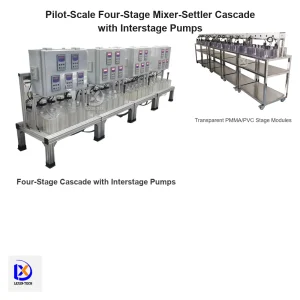
Pilot-Scale Four-Stage Mixer-Settler Cascade (with Interstage Pumps)
PriceOn request — the first reply carries a budget band and a lead time, within one business day -
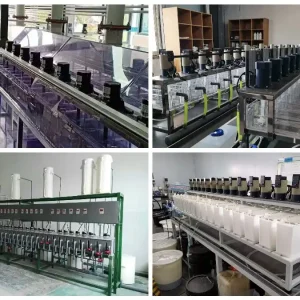
Lab Scale Mixer Settler
PriceOn request — the first reply carries a budget band and a lead time, within one business day -
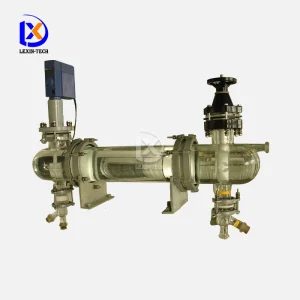
Horizontal Borosilicate Glass Tubular Mixer Settler
PriceOn request — the first reply carries a budget band and a lead time, within one business day