Lab-Scale Copper Electrowinning Cell
PriceOn requestLab-scale copper electrowinning cell with anode and cathode assembly, for current-efficiency, cathode quality and energy-consumption tests on real electrolyte.
Laboratory and pilot electrowinning cells: PMMA diaphragm cell 5–20 L, copper EW cell, and a six-cathode pilot cell with 0–500 A rectifier and 100 L circulation.
An electrowinning cell is where the flowsheet becomes metal: current passes between anode and cathode, and the target metal deposits on the cathode while oxygen evolves at the anode. This range covers the three cell types a project actually needs — a transparent diaphragm cell for mechanism work, a copper electrowinning cell for current-efficiency and cathode-quality tests, and a six-cathode pilot cell for continuous operation.
| Cell | Size / geometry | Electrical | Duty |
|---|---|---|---|
| Lab-Scale Diaphragm Electrolytic Cell | 5, 10, 20 L transparent PMMA, felt or ion-exchange membrane diaphragm | Bench rectifier | Separating anolyte and catholyte; membrane and diaphragm comparisons |
| Lab-Scale Copper Electrowinning Cell | Anode and cathode assembly, bench scale | Bench rectifier | Current efficiency, cathode quality and energy consumption on real electrolyte |
| Pilot Multi-Cathode Electrowinning Cell | Six cathodes, five anodes at 40 mm spacing, 100 L circulated electrolyte | 0–500 A rectifier | Continuous pilot campaigns and scale-up geometry |
Start with the question, not the metal. If the question is "which membrane", you need the transparent diaphragm cell: you have to see the anolyte and catholyte behave differently. If the question is "what current efficiency will this electrolyte give me", you need the copper cell, where cathode quality is visible and harvestable. If the question is "what does this circuit do over 200 hours", you need the multi-cathode pilot cell.
Anode spacing sets the voltage. The pilot cell runs 40 mm anode-to-cathode spacing, which is a scale-up-relevant number: closer spacing lowers cell voltage but raises the risk of short circuits and makes cathode harvesting harder. Comparing results at a different spacing is comparing different cells.
Circulation is part of the experiment. A 100 L circulated electrolyte loop is what makes the pilot cell a flow sheet rather than a beaker. Mass transfer, temperature rise and impurity build-up all depend on it.
Current density drives everything. Higher current density means more production per cathode area and worse cathode quality. The operating window is where both are acceptable, and it has to be found on your electrolyte.
Temperature control is not optional. Cell voltage turns into heat. Without control, a pilot campaign drifts in temperature and the current efficiency trend you report is really a temperature trend.
Impurities report to the cathode. Iron, chloride and organics all change morphology. If the cathode comes out nodular or brittle, check the electrolyte before blaming the rectifier.
Harvest on a schedule. Cathode thickness at harvest sets the entrainment and the handling losses. Short cycles give cleaner metal; long cycles give more metal per harvest — the pilot cell is where that trade is measured.
If anolyte chemistry matters — chlorine evolution, acid generation, membrane selection — you need the diaphragm. If you only care about cathode quality from a fixed electrolyte, the copper cell is simpler and closer to plant practice.
Six cathodes with five anodes at 40 mm spacing is enough to see edge effects, current distribution and the harvest routine. A single cathode hides all three.
Prices are quoted per project — every unit is sized for your duty. The first reply carries a budget band and a lead time, within one business day.
Showing all 3 results
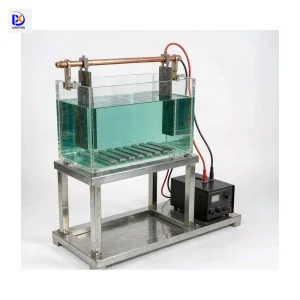
Lab-scale copper electrowinning cell with anode and cathode assembly, for current-efficiency, cathode quality and energy-consumption tests on real electrolyte.
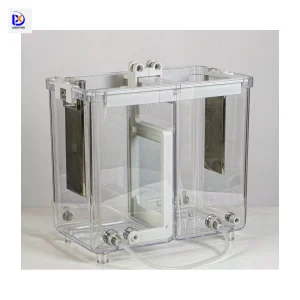
Transparent PMMA diaphragm cell in 5, 10 or 20 L bench sizes, separating anolyte and catholyte with a felt or ion-exchange membrane diaphragm. Pb-alloy or Ti/MMO anodes, 316L or titanium cathodes, 30-80 mm adjustable gap and a matched 0-10 V / 0-100 A rectifier.
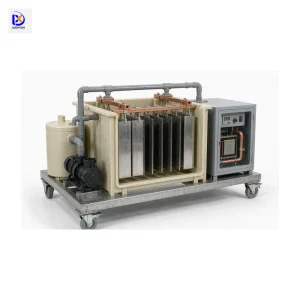
Pilot multi-cathode electrowinning cell with six cathodes, five anodes at 40 mm spacing, 0–500 A rectifier and 100 L circulated electrolyte: the geometry of a tankhouse cell at a scale where current efficiency, deposit quality and specific energy can be measured on real liquor.
We use cookies for analytics and advertising. You can accept or reject — rejecting does not affect your ability to request a quote.