Adhesive Bonding Process Mixer Settler
PriceOn requestAdhesively bonded mixer-settler, 100 mL to 5 L mixer volume, 1:3 or 1:4 phase ratio, in transparent PMMA or PVC for bench SX tests you can watch.
A mixer-settler is a stage, not a machine: an agitated box where two immiscible phases are contacted, followed by a quiet compartment where they separate by gravity. Stages are repeated in series counter-currently, and everything about the design follows from two ratios — the mixer-to-settler volume ratio and the stage count. This range covers 100 mL to 100 L per mixer, mixer-to-settler ratios of 1:3 or 1:4, and five vessel materials, so the same process can be developed on a bench and run as a continuous pilot skid.
| Decision | Options in this range | What drives it |
|---|---|---|
| Scale | LX-MS-100mL / 125 / 300 / 500 mL / 1 / 2 / 3 / 4 / 5 L / 15–100 L | Sample volume for bench work; 10–100 L/h aqueous feed for a pilot skid |
| Material | Transparent PMMA, transparent PVC, PP, PPH, PTFE, metals | See the phase boundary or resist the chemistry |
| Mixer : settler ratio | 1:3 or 1:4, custom on request | Settling rate of the dispersion you actually form |
| Fabrication | Adhesive bonding, hot gas welding, integral moulding, metal welding | Whether a seam is acceptable at the duty |
Transparent PMMA or PVC is what you want for method development. You can watch where the dispersion band sits, how long it takes to collapse, and whether an interphase crud layer is building — none of which you can see through PP. The limit is temperature: ambient to about 60 °C with PMMA/PVC, up to about 80 °C with PP/PPH.
PP and PPH are the workhorse materials for pilot and small commercial stages — welded, so repairable, and good to 80 °C. PTFE is for the chemistry that attacks everything else, and it is usually bought as an integral-moulded small stage rather than a large welded box, because PTFE does not weld into a pressure-tight seam easily.
Fabrication is not a detail. Adhesive bonding is how PMMA and PVC boxes are made and it is fine for aqueous duty at ambient temperature; hot gas welding is how PP/PPH boxes are made and it holds at 80 °C; integral moulding removes the seam entirely, which is why it is used for the small PTFE and PP stages where a leak path at the corner would be a permanent nuisance.
The mixer's job is mass transfer: it needs enough volume for the droplets to be created and for the reaction to go to completion, and that is measured in seconds to a couple of minutes of residence. The settler's job is phase separation, which is governed by the settling rate of the dispersion and therefore by the horizontal area available, not by volume alone. A 1:3 or 1:4 ratio is the practical outcome of that difference; if a test shows a slow, rag-like dispersion, the ratio goes up or the throughput comes down.
That is also why throughput is quoted in L/h of aqueous feed and marked "to be confirmed by test work". The stage that limits a train is almost always the settler whose dispersion band does not collapse fast enough, and no catalogue number replaces a batch settling test on your own liquor.
How many stages do I need? From the extraction isotherm: draw the operating line at your chosen O/A, step off the stages, then add one for the scrub and one or two for strip. A pilot cascade is normally built 3–6 stages because stage count is easy to add and expensive to remove.
Can I see the interface? Only with PMMA or PVC. If watching the dispersion band matters to your test programme, choose transparent material and stay inside its temperature limit.
What is the smallest volume that still means something? About 100 mL of mixer, if the O/A ratio and mixing intensity are representative. Below that, wall effects and the difficulty of measuring a dispersion band start to distort the result.
Do you supply the pumps and tanks? On the skid configurations, yes — interstage pumps with independent flow control, PP feed/scrub/strip tanks, and one-to-one or touchscreen control. On single stages, the stage only.
Send the isotherm, not the drawing. O/A ratio, stage count, temperature and the worst-case chemistry (chloride, fluoride, organics) determine material and ratio. With those four we will propose a configuration; without them any quote is a guess.
Prices are quoted per project — every unit is sized for your duty. The first reply carries a budget band and a lead time, within one business day.
Showing all 16 results
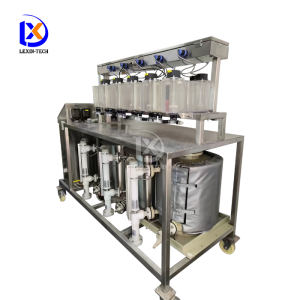
Adhesively bonded mixer-settler, 100 mL to 5 L mixer volume, 1:3 or 1:4 phase ratio, in transparent PMMA or PVC for bench SX tests you can watch.
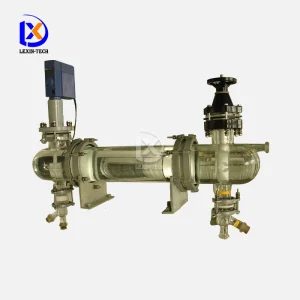
Horizontal borosilicate glass tubular mixer-settler, 300 mL to 5 L, 1:3 or 1:4 ratio — a visual, low-holdup contactor for bench SX and wash tests.
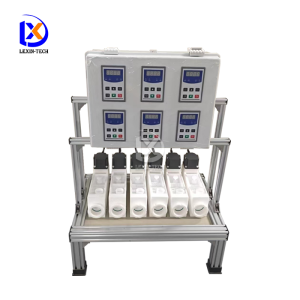
Integrally moulded mixer-settler, 100 mL to 1 L, 1:3 or 1:4 ratio, in PTFE or PP — no bonded seams, so aggressive reagents stay inside.
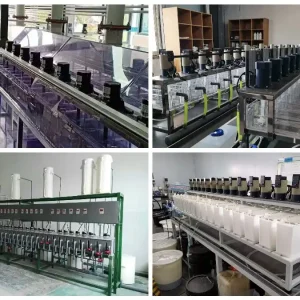
Lab-scale mixer-settler, 100 mL to 5 L, 1:3 or 1:4 mixer-to-settler ratio, available in PMMA, PVC, PP, PPH, PTFE or stainless steel.
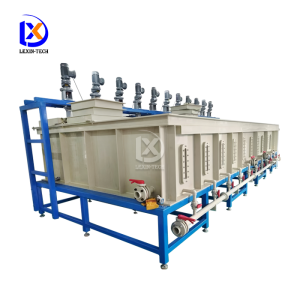
Pilot-scale mixer-settler, 15–100 L mixer volume, 1:3 or 1:4 ratio, in PVC, PP or PPH — staged to match your SX pilot flowsheet.
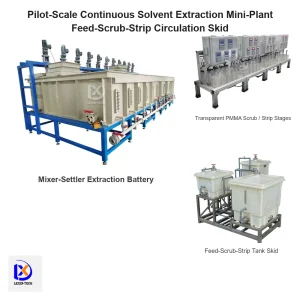
Continuous counter-current feed-scrub-strip mini-plant with 2-4 extraction, 1-2 scrub and 1-2 strip mixer-settler stages, PP stage boxes on a steel skid, 10-100 L/h aqueous feed and closed organic circulation – built to prove a complete SX flowsheet before pilot plant commitment.
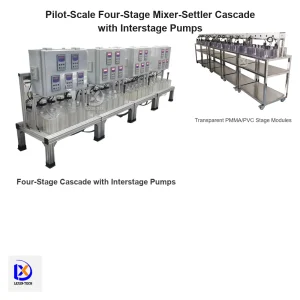
Four mixer-settler stages in series, each with its own interstage pump, turbine agitator and digital speed control, in PMMA/PVC, PP/PPH or SS316L construction. Built for flowsheet trials where aqueous and organic flows must be set independently, 10-50 L/h total throughput.
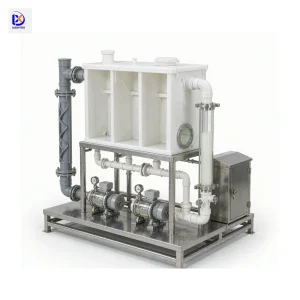
Static mixer-settler extraction unit with 12-element helical static mixers and no moving parts in the mixing zone: 20-200 L/h per stage across 1-4 series stages on one frame, baffled settlers with an interface sight glass, in PVC-U, PP or PPH with PVDF/PTFE lining options.
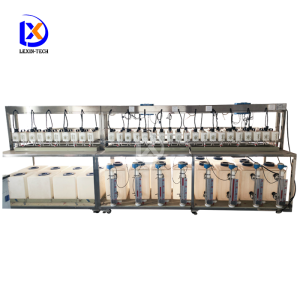
PP mixer-settler, 100 mL to 5 L, 1:3 or 1:4 ratio, hot-gas welded polypropylene — the default for acidic SX where visibility is optional.
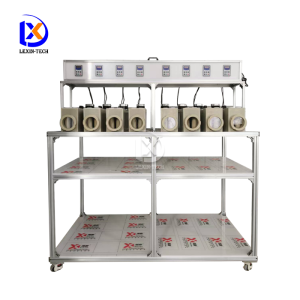
PPH (polypropylene homopolymer) mixer-settler, 100 mL to 5 L, 1:3 or 1:4 ratio — better temperature and chemical resistance than standard PP.
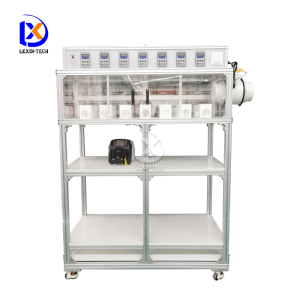
PTFE mixer-settler, 100 mL to 1 L, 1:3 or 1:4 ratio, integrally moulded — for aggressive reagents and hot SX duty where nothing else lasts.
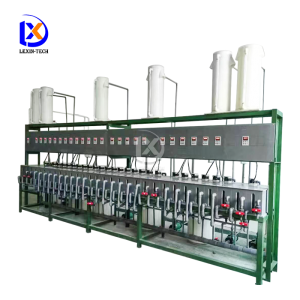
PVC mixer-settler, 100 mL to 5 L, 1:3 or 1:4 ratio, hot-gas welded — a low-cost, chemically inert option for ambient-temperature SX testwork.
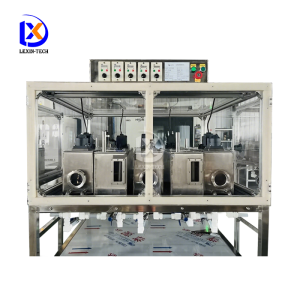
Stainless steel mixer-settler, 100 mL to 5 L, 1:3 or 1:4 ratio, TIG welded in 304, 316L or duplex — for high-temperature or solvent-free duty.
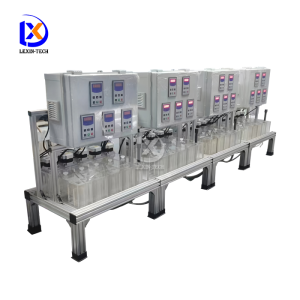
Transparent PMMA mixer-settler, 100 mL to 5 L, 1:3 or 1:4 ratio — see the dispersion band and diagnose flooding while the test runs.
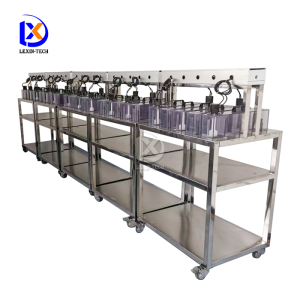
Transparent PVC mixer-settler, 100 mL to 5 L, 1:3 or 1:4 ratio, hot-gas welded — visible mixing and settling at lower cost than PMMA.
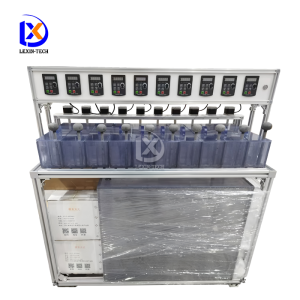
Hot-gas and TIG welded mixer-settler, 100 mL to 5 L, 1:3 or 1:4 ratio, in PVC, PP, PPH or stainless steel — fabrication matched to your reagent.
We use cookies for analytics and advertising. You can accept or reject — rejecting does not affect your ability to request a quote.