Pilot-Scale Static Mixer-Settler Extraction Unit
PriceOn request — the first reply carries a budget band and a lead time, within one business day
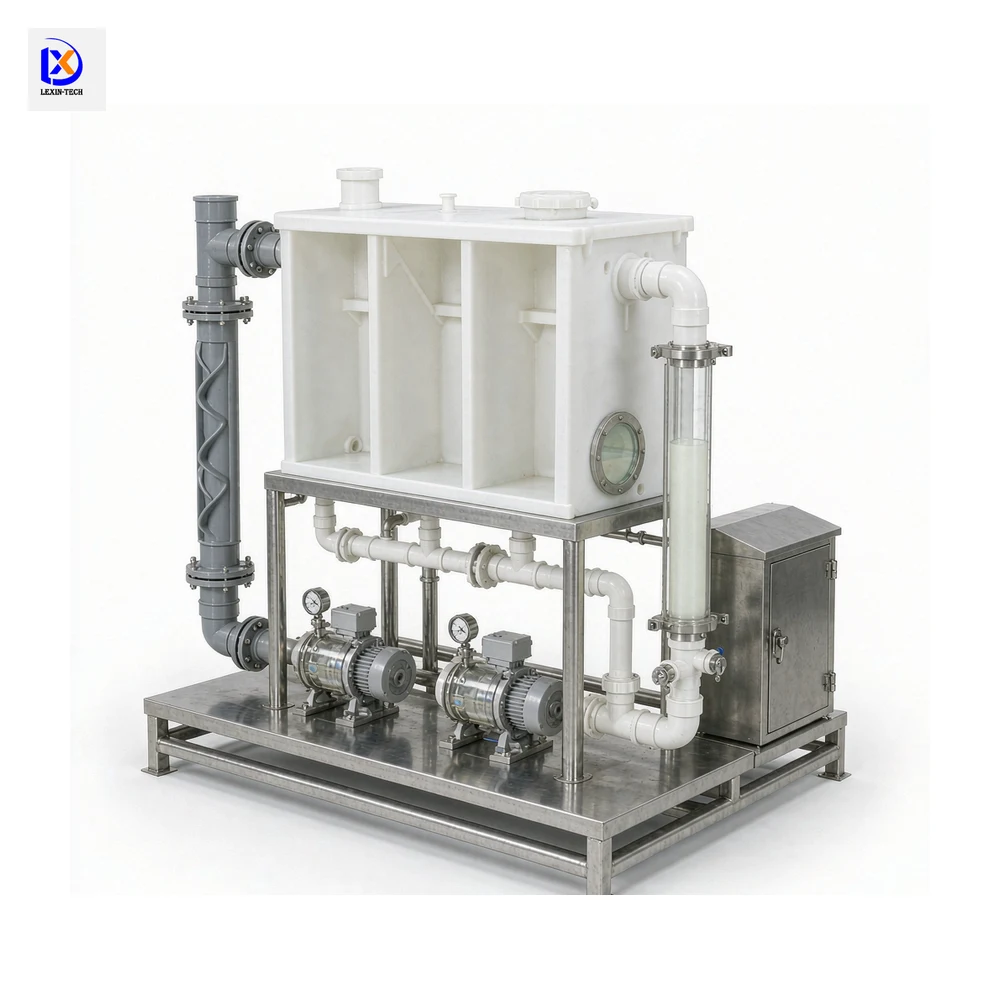
Static mixer-settler extraction unit with 12-element helical static mixers and no moving parts in the mixing zone: 20-200 L/h per stage across 1-4 series stages on one frame, baffled settlers with an interface sight glass, in PVC-U, PP or PPH with PVDF/PTFE lining options.
- Built to order
Engineered against your feed assay and throughput - Bench & pilot tested
Sample testing before the flowsheet is frozen - Export documented
Pre-tested, skid-mounted, documented for customs - EN / ES / RU / AR
Technical support in four languages
A static mixer-settler removes the agitator from the extraction stage and keeps everything else. Two phases are driven through a pipe packed with helical mixing elements by the transfer pumps alone, then disperse and settle in a conventional gravity settler. For pilot campaigns that run unattended for weeks — on copper, nickel laterite or similar liquors — the appeal is direct: no mechanical seal to weep, no impeller to foul, no mixing motor to fail at two in the morning, while the settling side keeps the measurement quality a gravity settler gives you.
Mixing without a motor
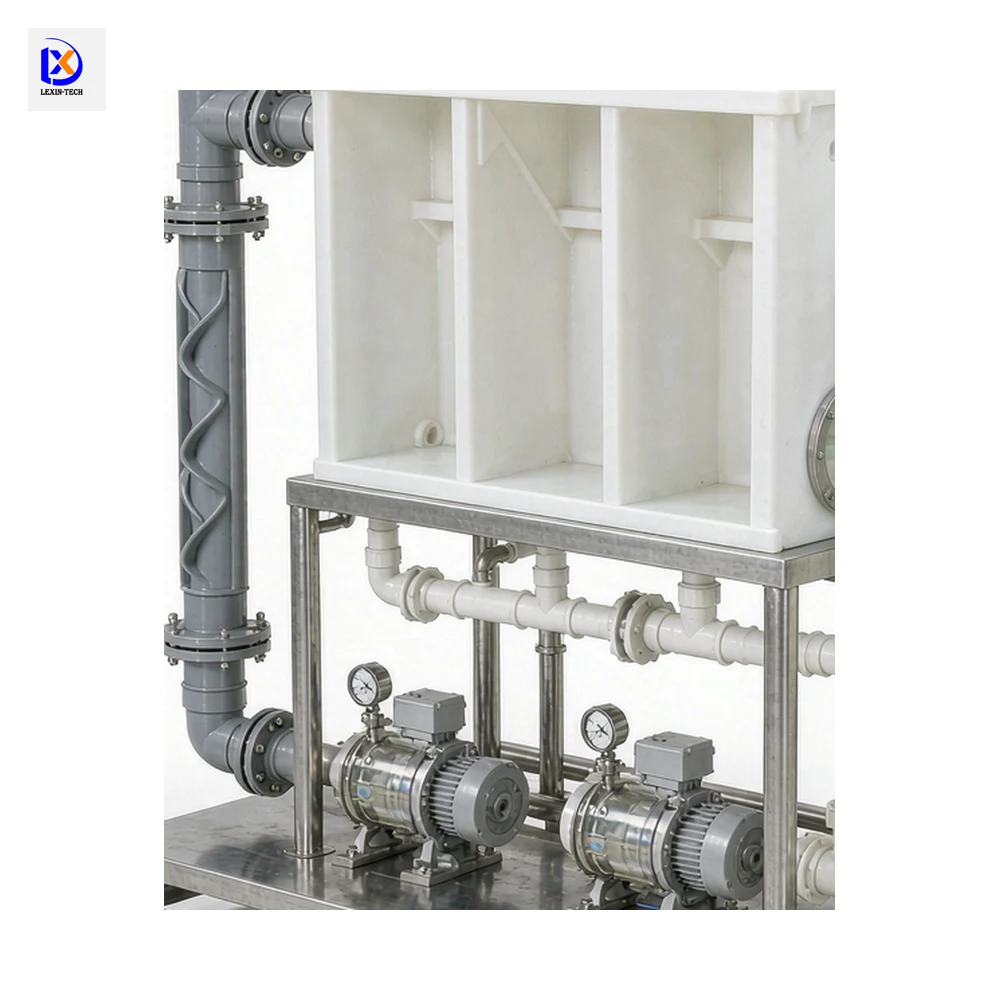
The mixing section is an in-line static mixer: a 12-element helical (SMX-type) element stack held between flanged pipe spools. Each element splits and reorients the flow, so the two phases are re-dispersed every few pipe diameters with zero mixing power drawn from anywhere but the pumps themselves. There is no speed to tune, which is both the strength and the discipline of the design — dispersion intensity is set by flow rate and phase ratio, so those two variables carry all the tuning work of the campaign.
What the settler shows you
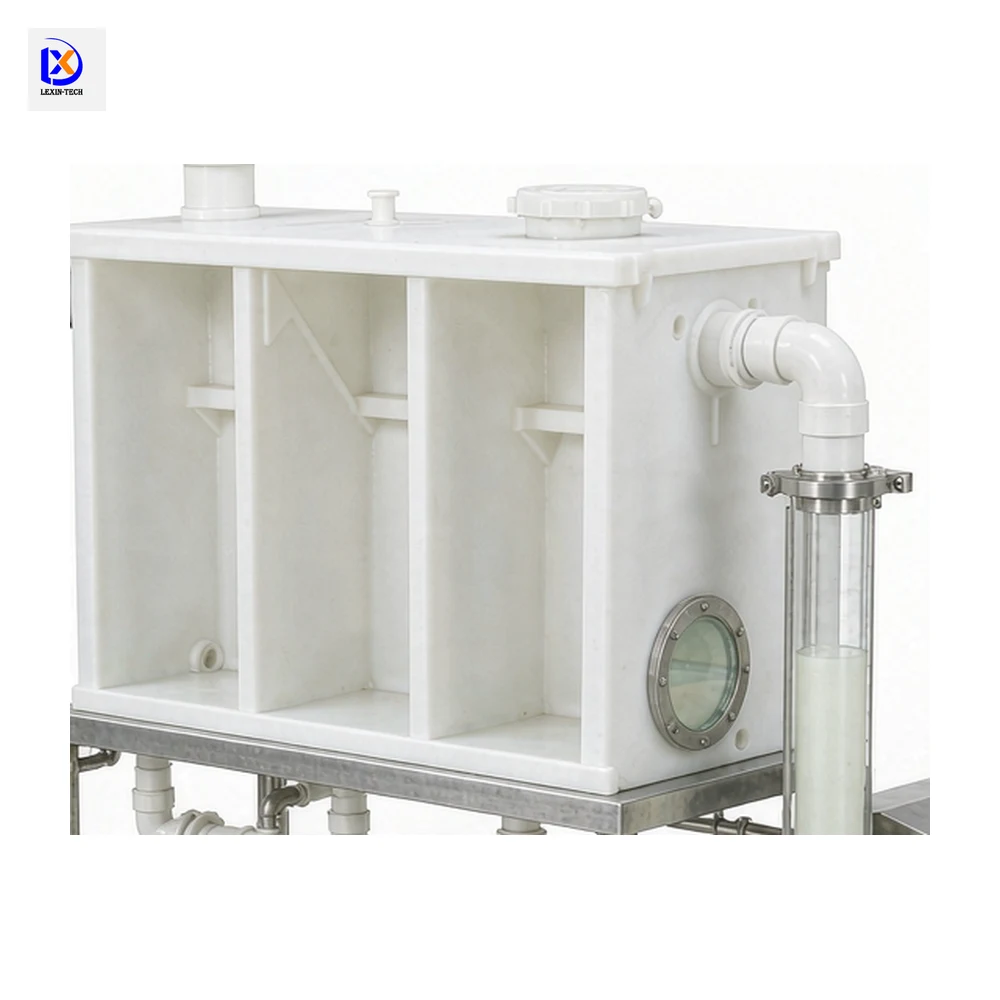
The settler is a rectangular PP or PVC-U box with three transverse baffles, an outlet weir and a vertical interface standpipe with a borosilicate sight glass. Dispersion band thickness and the organic-aqueous interface position are read directly through the glass, stage by stage, while the unit runs — no shutdown, no probe, no interpretation. Each stage carries sampling valves and an inlet pressure gauge as standard; pH, ORP and interface level transmitters are optional when the campaign needs logged data rather than an operator walking the line.
Sizing that carries over to production
Throughput per stage is 20–200 L/h combined aqueous plus organic, to be confirmed by test work, at O/A ratios from 1:1 to 1:5. The mixer-to-settler volume ratio is 1:3 or 1:4. What matters more than either number is the settler criterion: it is sized on a specific throughput of 20–40 mm/min — the same design basis used for production settlers. That is why the stage efficiency measured on this skid transfers to the flowsheet as a design number rather than a bench curiosity. If you want the arithmetic behind that criterion, the mixer-settler design and sizing guide works through it, and the entrainment control article covers the failure mode a static mixer-settler is most often bought to avoid. Final stage volume and piping layout are fixed on the approved drawing after test work on your liquor.
Materials, temperature and pressure boundaries
Wetted materials are PVC-U, PP or PPH, selected against your liquor. The chemical boundary is sulphuric acid up to 150 g/L, fluoride-free and free-chlorine-free; chloride-bearing or fluoride systems move to PVDF or PTFE-lined construction, or titanium wetted parts. Temperature tolerance follows the material: ambient to 50 °C for PVC-U, ambient to 80 °C for PP and PPH. Operation is atmospheric gravity settling throughout — the transfer pumps are rated 0.4 MPa, and the unit is not a pressure vessel, so anything requiring pressure duty needs a different contactor.
Pumps, staging and skid scope
Transfer is by two 0.37–0.75 kW pumps with PVC or PTFE wetted parts; a VFD on each is optional and worth specifying if you plan to sweep flow rates during the campaign. Stages come as 1–4 series-connected units on one frame, quoted per stage, so a single-stage efficiency test and a full countercurrent train share the same hardware. The in-line mixing approach belongs to the wider mixer-settler range, where the same logic scales up in pipe diameter rather than box volume.
Why is the unit quoted per stage?
Because campaigns rarely need the same stage count twice. Quoting per stage lets a single-stage test grow into a 3- or 4-stage train — or shrink — without repricing hardware you will not use. 1–4 stages connect in series on one frame.
What O/A ratio can the skid run?
Phase ratios from 1:1 to 1:5 are within the design range. The static mixer disperses whatever the pumps feed it, but very high ratios push settler loading up fast, so the 20–40 mm/min specific throughput usually sets the real ceiling — to be confirmed by test work on your liquor.
What happens with chloride in the liquor?
The standard PVC-U/PP/PPH build is limited to fluoride-free, free-chlorine-free liquors with sulphuric acid up to 150 g/L. Chloride-bearing systems require PVDF or PTFE-lined wetted parts or titanium; send the full liquor analysis so the material build is settled at quotation, not mid-campaign.
Send your liquor analysis, target stage count and throughput range via the quotation page, and we will return a per-stage scope and material build.
Specifications
| Mixer type | In-line static mixer, 12-element helical (SMX-type), no agitator, no moving parts, no mixing power |
|---|---|
| Mixer-to-settler volume ratio | 1:3 or 1:4 (settler sized on 20-40 mm/min specific throughput) |
| Throughput per stage | 20-200 L/h combined aqueous + organic (to be confirmed by test work) |
| Stages per skid | 1-4 stages, series-connected on one frame, quoted per stage |
| Wetted materials | PVC-U, PP or PPH; PVDF / PTFE-lined option for chloride-bearing liquors |
| Settler internals | 3 transverse baffles, outlet weir, interface standpipe with borosilicate sight glass |
| Transfer pumps | 2 x 0.37-0.75 kW, PVC / PTFE wetted, VFD optional |
| Operating temperature | Ambient to 50 C (PVC-U), ambient to 80 C (PP / PPH) |
| Operating pressure | Atmospheric gravity settling; pumps rated 0.4 MPa; not a pressure vessel |
| Chemical compatibility | H2SO4 |
Values are the documented specifications for this model. Final dimensions are confirmed on the approved drawing before production.
Frequently asked questions
Why is the unit quoted per stage?
Because campaigns rarely need the same stage count twice. Quoting per stage lets a single-stage test grow into a 3- or 4-stage train — or shrink — without repricing hardware you will not use. 1–4 stages connect in series on one frame.
What O/A ratio can the skid run?
Phase ratios from 1:1 to 1:5 are within the design range. The static mixer disperses whatever the pumps feed it, but very high ratios push settler loading up fast, so the 20–40 mm/min specific throughput usually sets the real ceiling — to be confirmed by test work on your liquor.
What happens with chloride in the liquor?
The standard PVC-U/PP/PPH build is limited to fluoride-free, free-chlorine-free liquors with sulphuric acid up to 150 g/L. Chloride-bearing systems require PVDF or PTFE-lined wetted parts or titanium; send the full liquor analysis so the material build is settled at quotation, not mid-campaign.
Related products
-
Pilot-Scale Spray Extraction Column
PriceOn request — the first reply carries a budget band and a lead time, within one business day -
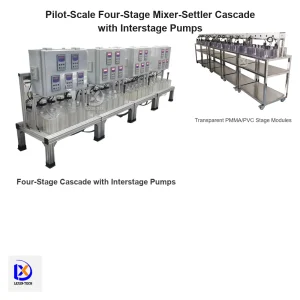
Pilot-Scale Four-Stage Mixer-Settler Cascade (with Interstage Pumps)
PriceOn request — the first reply carries a budget band and a lead time, within one business day -
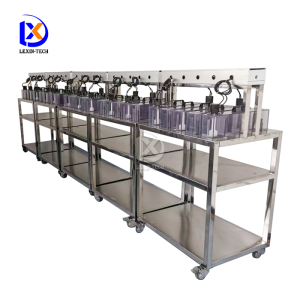
Transparent PVC Mixer Settler
PriceOn request — the first reply carries a budget band and a lead time, within one business day -
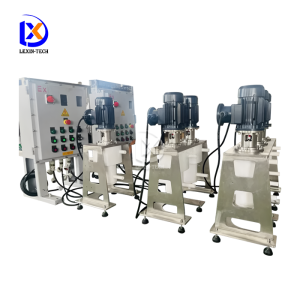
80mm Rotary Drum Centrifugal Extractor
PriceOn request — the first reply carries a budget band and a lead time, within one business day