Pilot-Scale Multi-Stage Centrifugal Extraction Skid (3 Extractors + Tanks)
PriceOn request — the first reply carries a budget band and a lead time, within one business day
Pilot extraction skid of three rotary-drum centrifugal extractors in series, 50 mm or 80 mm rotors with independent VFDs, 20-200 L/h per stage and 50-500 L/h combined, feed/scrub/strip tanks on one frame, and pressure-retaining parts supplied with material and hydrotest certificates.
- Built to order
Engineered against your feed assay and throughput - Bench & pilot tested
Sample testing before the flowsheet is frozen - Export documented
Pre-tested, skid-mounted, documented for customs - EN / ES / RU / AR
Technical support in four languages
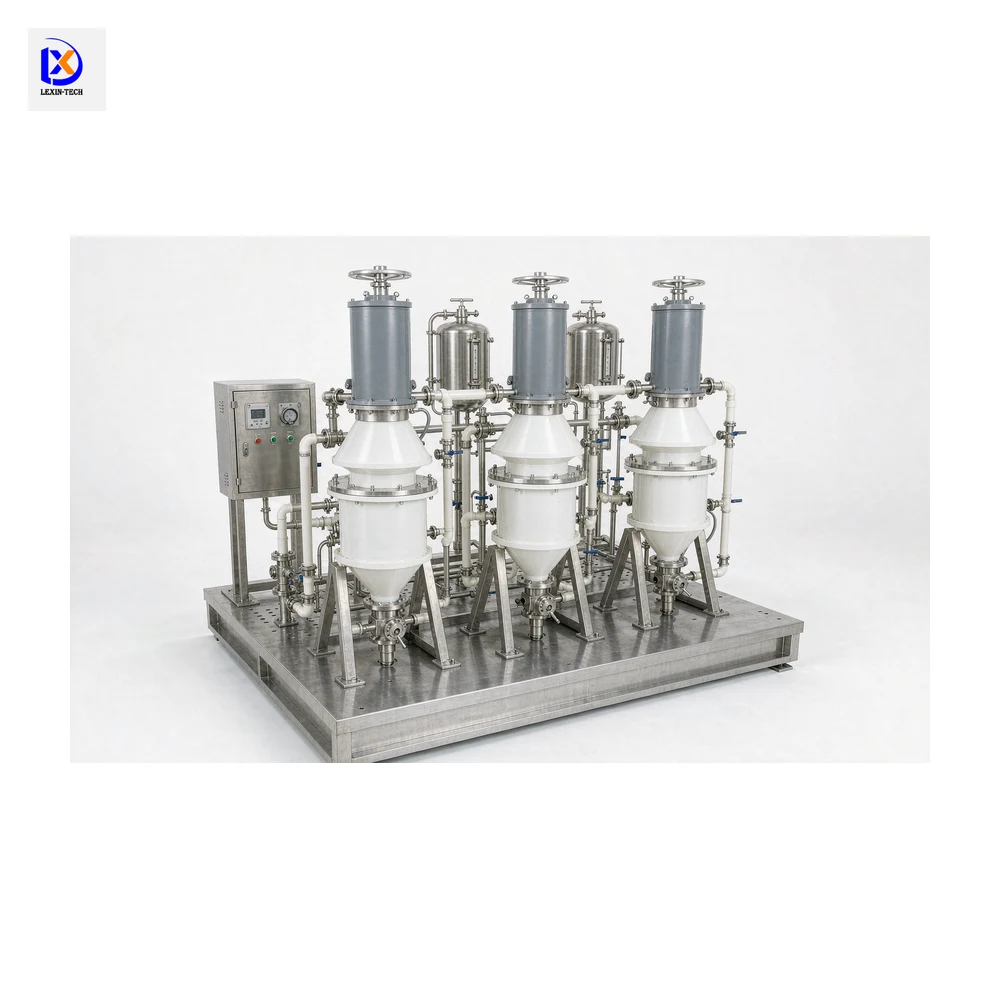
A single centrifugal extractor proves that a stage works. It cannot tell you how a circuit works — how organic inventory distributes over several stages, where the interface drifts when the O/A ratio changes, or what stage efficiency actually is once streams recirculate. This skid answers the circuit questions: three rotary-drum centrifugal extractors piped in series on one frame, each with its own drive, its own metering and its own sampling point, flanked by the feed, scrub and strip solution tanks a complete train needs.
Three machines, one frame
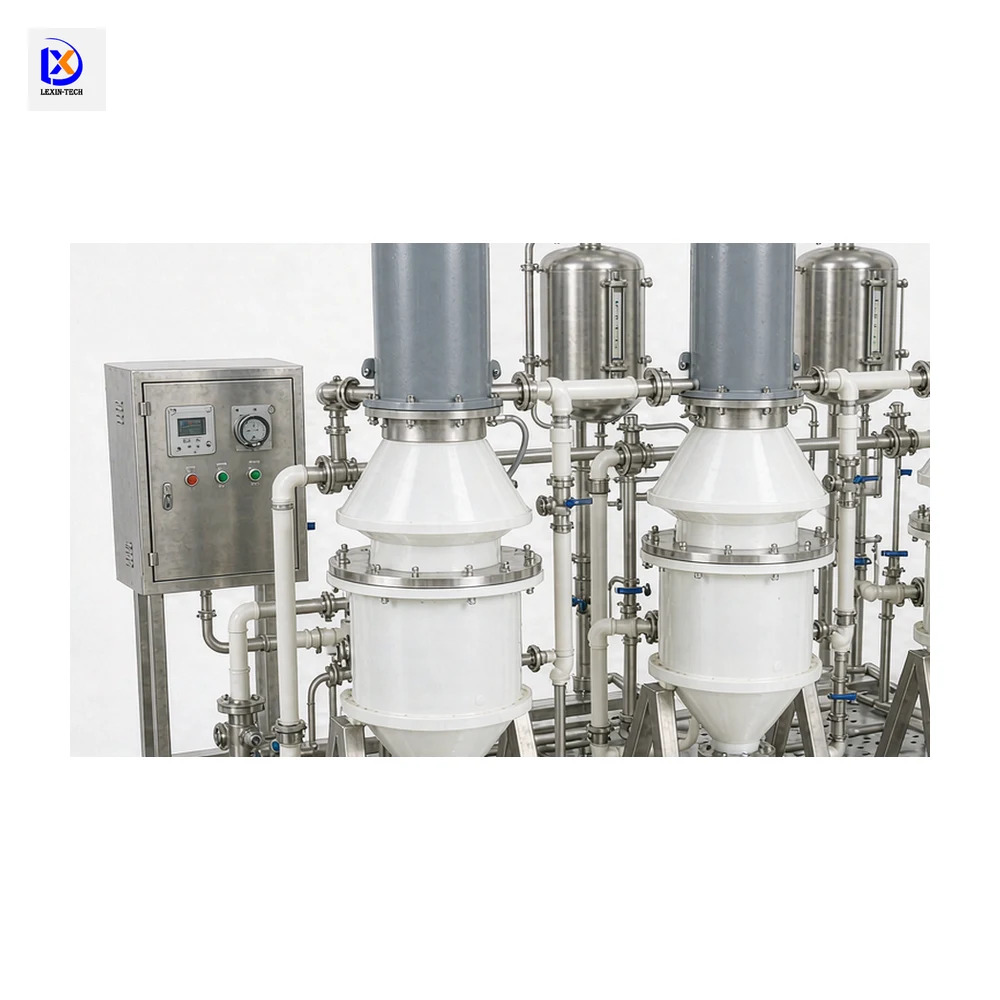
The layout is three extractors — 50 mm or 80 mm rotor, your choice confirmed after test work — mounted side by side with interstage transfer lines, valves and pressure taps between them. Two 50–200 L solution tanks in PP or 316L, with level sight glasses, sit at the rear of the frame and hold feed, scrub or strip liquor depending on how you pipe the train. The local control panel carries an independent VFD for every unit, so stage 1 can be run at different intensity than stages 2 and 3 — which is exactly what a scrub stage usually wants. The whole assembly is skid-mounted: it lifts into a pilot bay, commissions in a day, and re-pipes for a different flowsheet without cutting the frame.
Choosing between 50 mm and 80 mm rotors
Throughput per stage is 20–200 L/h, with 50–500 L/h combined across the skid, to be confirmed by test work. Rotor diameter sets residence time and centrifugal force together, in the same proportion as the production machine — which is the quiet argument for this skid: stage efficiency measured at the pilot rotor is the number to design the industrial circuit on, because the geometry scales. Phase ratio runs from 1:1 to 1:10, metered independently at each stage, so the extraction and strip sections can run at different O/A without shared-pump compromises. The O/A ratio calculation guide covers how those per-stage settings are fixed. Each unit is driven by a 0.37–0.75 kW motor at 3,000–6,000 rpm under its own VFD.
Instrumentation and control depth
The standard panel gives digital speed readout, level and pressure indication — enough to run and record a three-stage campaign with one operator. For campaigns feeding a design package, PLC control with SCADA is optional, which turns the skid into a self-logging pilot line rather than a supervised one. The step from this skid to a full flowsheet pilot is laid out in the pilot solvent extraction plant scope, where extraction, scrub and strip are combined with feed preparation and downstream steps.
Materials and design basis
Wetted parts are 316L stainless steel for the housings, with PTFE or PVDF internals and transfer lines; a titanium option covers more aggressive duties. The chemical boundary is sulphuric acid up to 150 g/L, fluoride-free; chloride above 200 mg/L requires titanium or PTFE-lined wetted parts. Operation is atmospheric, and pressure-retaining parts are designed to GB / ASME VIII and supplied with material and hydrotest certificates — worth having on file before the skid enters a client pilot bay. The machines themselves are members of the centrifugal extractor range, so single-unit behavior documented on those pages applies stage by stage.
Can we add a fourth stage later?
Three stages come standard; 4–6 stage skids are quoted on request. Extending an existing skid is a practical question of frame space and hydraulics — tell us at enquiry stage if growth is likely, and the frame and control panel are sized for it.
Which rotor size should we order?
50 mm or 80 mm per unit is confirmed after test work on your liquor. As a rule of thumb, if your per-stage throughput target sits at the top of the 20–200 L/h range, the 80 mm rotor holds its efficiency there more comfortably.
What certificates come with the skid?
Pressure-retaining parts are designed to GB / ASME VIII and supplied with material and hydrotest certificates. The wetted-material certification covers 316L housings with PTFE/PVDF internals; titanium builds are documented the same way.
To configure a three-stage (or larger) train, send your flowsheet, liquor analysis and throughput targets via the quotation page.
Specifications
| Configuration | 3 x rotary-drum centrifugal extractors in series on one skid with feed, scrub and strip solution tanks; 3 stages standard, 4-6 stage skids quoted on request |
|---|---|
| Rotor diameter | 50 mm or 80 mm per unit, 3 units per skid |
| Throughput | 20-200 L/h per stage, 50-500 L/h combined (to be confirmed by test work) |
| Wetted materials | 316L stainless steel housing, PTFE / PVDF internals and transfer lines, titanium option |
| Drive | 0.37-0.75 kW per unit, 3,000-6,000 rpm, independent VFD on each extractor |
| Phase ratio (O/A) | 1:1 to 1:10, independently metered per stage |
| Solution tanks | 2 x 50-200 L PP or 316L tanks with level sight glass, mounted on the same frame |
| Control & instrumentation | Local control panel with VFDs, digital speed readout, level and pressure indication; PLC + SCADA optional |
| Design basis | Atmospheric operation; pressure-retaining parts designed to GB / ASME VIII and supplied with material and hydrotest certificates |
| Chemical compatibility | H2SO4 |
Values are the documented specifications for this model. Final dimensions are confirmed on the approved drawing before production.
Frequently asked questions
Can we add a fourth stage later?
Three stages come standard; 4–6 stage skids are quoted on request. Extending an existing skid is a practical question of frame space and hydraulics — tell us at enquiry stage if growth is likely, and the frame and control panel are sized for it.
Which rotor size should we order?
50 mm or 80 mm per unit is confirmed after test work on your liquor. As a rule of thumb, if your per-stage throughput target sits at the top of the 20–200 L/h range, the 80 mm rotor holds its efficiency there more comfortably.
What certificates come with the skid?
Pressure-retaining parts are designed to GB / ASME VIII and supplied with material and hydrotest certificates. The wetted-material certification covers 316L housings with PTFE/PVDF internals; titanium builds are documented the same way.
Related products
-
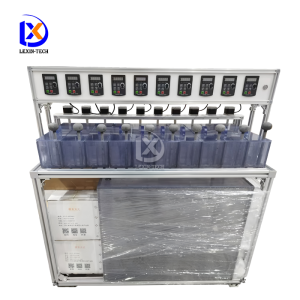
Lab Scale Mixer Settler
PriceOn request — the first reply carries a budget band and a lead time, within one business day -
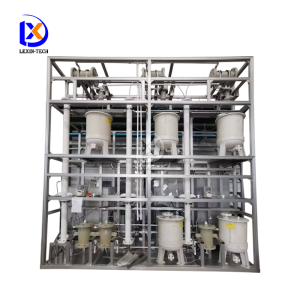
Welding Process Mixer Settler
PriceOn request — the first reply carries a budget band and a lead time, within one business day -
Packed Extraction Column
PriceOn request — the first reply carries a budget band and a lead time, within one business day -
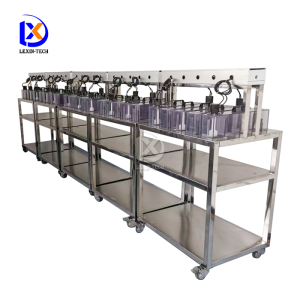
Transparent PVC Mixer Settler
PriceOn request — the first reply carries a budget band and a lead time, within one business day