Lab-Scale Agitated Leaching and Solid-Liquid Separation Unit
PriceOn requestLab unit combining a 5–20 L glass leach reactor with pH/ORP control and a 240 mm PP vacuum filter — leaching and solid-liquid separation in one skid.
Bottle roll, column percolation, pressure autoclave and combined leach-plus-filtration units for leach kinetics, reagent consumption and recovery test work.
Leaching test work answers three questions before anything is built: how fast, how much reagent, and how much metal comes out. This range covers the four configurations that answer them at bench and pilot scale.
| Unit | Configuration | What it answers |
|---|---|---|
| Bottle Roll Leaching Test Machine | Four stations, 500 mL–5 L bottles, 10–200 rpm digital control | Kinetics and reagent consumption on slurries; cyanidation and dilute acid |
| Column Percolation Leaching Unit | 100 mm × 1,500 mm ore bed, perforated-plate irrigation, 0.05–0.5 L/kg/h | Heap-leach behaviour: percolation, recovery against irrigation rate |
| Laboratory Pressure Leaching Autoclave | Agitated, heated, pressure-rated vessel | Oxidative leach of refractory ores and concentrates |
| Agitated Leaching + Solid-Liquid Separation Unit | 5–20 L glass reactor with pH/ORP control plus 240 mm PP vacuum filter | Leach and filtration in one skid, with the liquor actually separated |
Bottle roll is the screening tool. Four stations at once, controlled rpm, bottles you can open and sample. It is how you rank grind sizes and reagent levels before committing to anything expensive.
Column test is not optional for heap leaching. Bottle roll results do not transfer to a heap: percolation, channelling and solution-to-solids ratio behave completely differently in a bed. The 100 mm × 1,500 mm column with 0.05–0.5 L/kg/h irrigation is the smallest rig that still shows those effects.
Autoclave when the mineral is refractory. Pressure and oxygen change the chemistry, not just the rate. If the target metal is locked in a sulphide matrix, no amount of ambient-pressure optimization gets there.
The combined unit is for closure. A leach result you cannot filter is half a result. Running the leach and the solid–liquid separation on one skid with pH and ORP control gives you a liquor you can actually assay and a residue you can wash.
Control pH and ORP, and log them. Acid consumption and oxidant demand are the two biggest operating costs in leaching, and both are invisible if the test only records the final assay.
Keep the solution-to-solids ratio honest. A test at a ratio the plant will not use gives a recovery the plant will not get. Scale the ratio first, then the reagent.
Sample on a schedule, not at the end. Kinetics come from the shape of the curve. A single final assay tells you the endpoint and nothing about residence time.
Wash the residue. Metal in the entrained liquor is not recovery. Displacement washing on the filter is part of the test, not a detail afterwards.
Until the curve flattens — that is the point of taking samples during the run. Typical programmes run from hours to a few days depending on the mineral.
Only if you are not doing heap leaching. For a heap, percolation behaviour is the design basis and a bottle roll cannot see it.
Prices are quoted per project — every unit is sized for your duty. The first reply carries a budget band and a lead time, within one business day.
Showing all 4 results
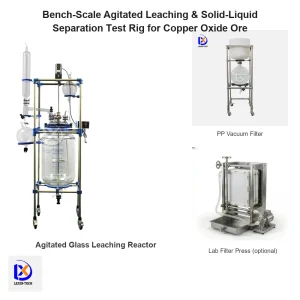
Lab unit combining a 5–20 L glass leach reactor with pH/ORP control and a 240 mm PP vacuum filter — leaching and solid-liquid separation in one skid.
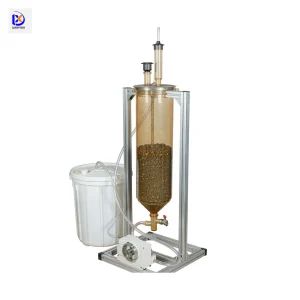
A floor-standing column leach unit with a 100 mm x 1500 mm ore bed, perforated-plate irrigation and peristaltic control from 0.05 to 0.5 L/kg/h, for heap and dump leach simulation in acid, alkaline, cyanide and bio-leach systems.
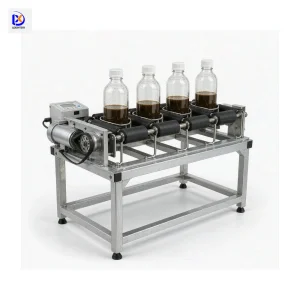
A four-station bench-top bottle roll machine for gold cyanidation and dilute-acid leach kinetics: 500 mL to 5 L bottles, 10-200 rpm digital speed control and continuous 24-hour runs, built for diagnostic leaching and reagent screening before scale-up.
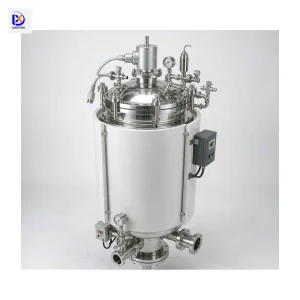
Laboratory pressure leaching autoclave with agitated, heated and pressure-rated vessel for oxidative leach tests on refractory ores and concentrates.
We use cookies for analytics and advertising. You can accept or reject — rejecting does not affect your ability to request a quote.